

India is building out its naval strength with three homegrown classes of warships built for combat, seabed surveys and coastal defence. The recent commissioning of INS Dunagiri, INS Sanshodhak, INS Agray and INS Mahendragiri adds to the Navy’s domestically built fleet and reflects the push toward self-reliance in defence manufacturing.
The three classes: Nilgiri-class stealth frigates, Sandhayak-class survey vessels and Arnala-class anti-submarine warfare craft cover different pieces of India’s maritime security needs and operate across the Indian Ocean Region.
A coastline that demands a lot of coverage
The Indian Navy watches over a coastline running more than 11,000 kilometres, an Exclusive Economic Zone of nearly 2.4 million square kilometres, and shipping lanes that carry close to 90% of India’s trade by volume. Covering that much water means the Navy needs ships suited to deep sea combat, coastal patrol, and everything in between.
The Nilgiri, Sandhayak and Arnala classes were built with exactly that spread of jobs in mind: surface warfare, hydrography, and anti-submarine work in shallow coastal waters.
Nilgiri-class frigates handle surface combat
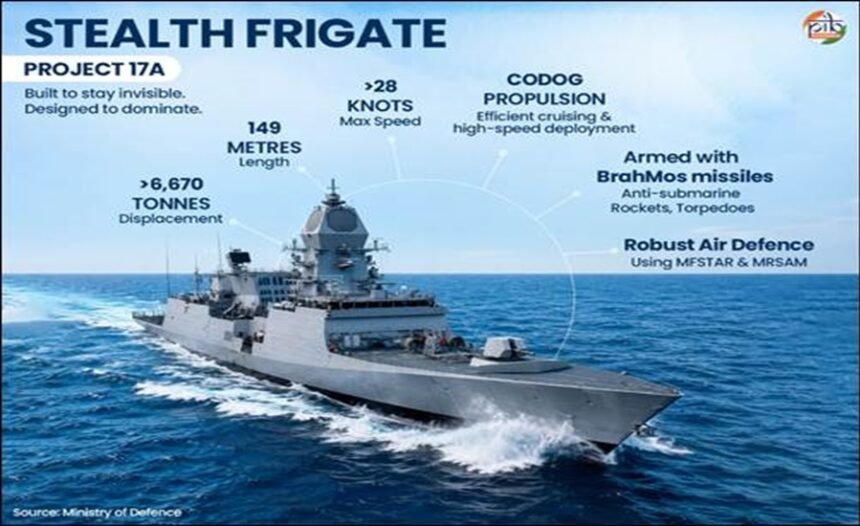
The Nilgiri-class frigates, built under Project 17A, are the newest generation of India’s stealth warships, designed for anti-air, anti-surface and anti-submarine missions. Their reduced radar, thermal and acoustic signatures make them harder to detect during combat, and they carry advanced sensors, radar, sonar and helicopters for long-range operations.
The class has seven ships in total: INS Nilgiri, INS Himgiri, INS Taragiri, INS Udaygiri, INS Dunagiri, INS Mahendragiri, and INS Vindhyagiri, which is still under construction.
Each ship runs about 149 metres long, displaces roughly 6,670 tonnes, and uses a Combined Diesel or Gas propulsion system that gets it up to 28 knots. Weapons on board include BrahMos supersonic cruise missiles, medium-range air defence systems and close-in weapon systems.
Sandhayak-class ships map the seafloor
The Sandhayak-class Survey Vessels give India the ability to chart seabeds, map coastal waters and collect oceanographic data that both the Navy and maritime trade depend on. The class includes INS Sandhayak, INS Nirdeshak, INS Ikshak and INS Sanshodhak, the last of which was just commissioned as the final ship in the series.
These vessels carry multi-beam echo sounders, side-scan sonar and autonomous underwater vehicles for detailed seabed surveys and nautical charting. Each ship measures around 110 metres, displaces about 3,400 tonnes, and can cover missions up to 6,500 nautical miles. Beyond survey work, they can pitch in on disaster relief, carry helicopters, and even serve as hospital ships in emergencies.
Arnala-class craft guard shallow coastal waters
The Arnala-class Anti-Submarine Warfare Shallow Water Craft are built to find and neutralise submarines in shallow coastal areas where bigger warships struggle to operate. The class has eight vessels: Arnala, Androth, Anjadip, Amini, Abhay, Agray, Akshay and Ajay. INS Agray, the fourth ship in the class, was recently commissioned.
Garden Reach Shipbuilders and Engineers built these in partnership with L&T Shipbuilding, with the goal of replacing the ageing Abhay-class corvettes. Each craft is about 77.6 metres long, displaces close to 900 tonnes, and reaches speeds of roughly 25 knots using waterjet propulsion, which helps with maneuvering in shallow water. They carry lightweight torpedoes, anti-submarine rockets, and sonar and combat management systems for underwater detection and engagement.
Building ships at home
These programmes show how far India’s shipyards have come in designing and building advanced naval platforms domestically. The Project 17A frigates run at roughly 75% indigenous content, and the Sandhayak-class survey vessels top 80%.
Indian shipyards and supply chains have carried much of this work, supporting hundreds of small and medium enterprises and creating thousands of jobs, direct and indirect, across the defence manufacturing sector. Of the 66 ships and submarines currently on order for the Navy, 64 are being built in India.
Key Takeaway: These ships help with safe navigation, maritime trade, disaster response and cooperation with other countries in the region. Survey vessels support port development, offshore energy exploration and fisheries management, while the combat and anti-submarine ships protect shipping routes and maritime infrastructure.
The programmes tie into India’s broader maritime efforts, including SAGAR (Security and Growth for All in the Region) and MAHASAGAR (Mutual and Holistic Advancement for Security and Growth Across Regions), both aimed at strengthening security and cooperation across the Indian Ocean and the wider Global South. With these new ships in service, India keeps building on its role as a major naval power in the region.
MCQs:
- Which three classes of indigenous naval vessels were recently highlighted by the commissioning of new ships?
A) Kolkata, Kamorta and Kalvari classes
B) Nilgiri, Sandhayak and Arnala classes
C) Shivalik, Rajput and Kora classes
D) Vikrant, Arihant and Delhi classes
- INS Dunagiri and INS Mahendragiri belong to which class of vessels?
A) Arnala-class
B) Sandhayak-class
C) Nilgiri-class
D) Kamorta-class
Read more: CPI June 2026: Inflation Drops as New 2024 Base Shows Stable Economy