
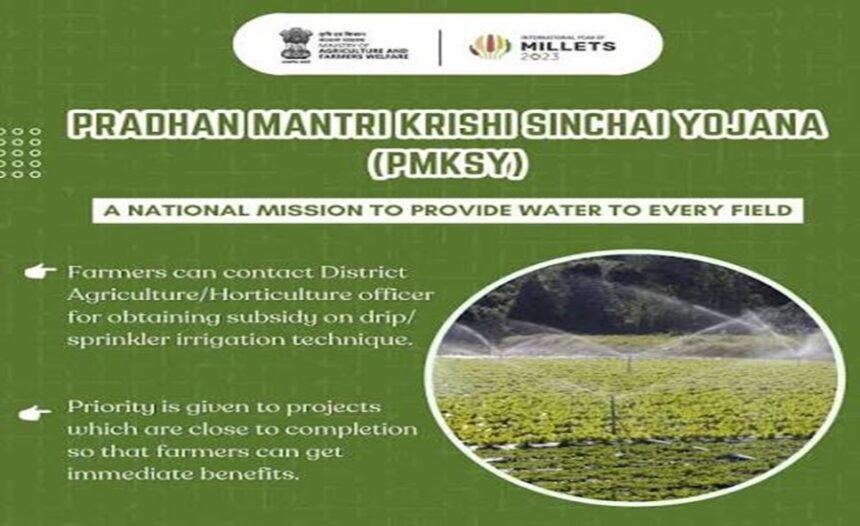
The Pradhan Mantri Krishi Sinchai Yojana (PMKSY), launched in 2015-16, has pushed irrigation coverage forward, tightened up water-use efficiency, and lifted farm productivity across the country. It runs as an umbrella scheme, folding in the Accelerated Irrigation Benefit Programme (AIBP) and Har Khet Ko Pani (HKKP) under the Ministry of Jal Shakti, plus watershed development and micro-irrigation pieces handled by other ministries.
Where the coverage has grown
Since April 2016, AIBP has created 30.66 lakh hectares of irrigation potential nationwide, with 4.09 lakh hectares of that coming just in the last three years (2023-24 to 2025-26). The Surface Minor Irrigation piece of HKKP added another 4.29 lakh hectares, and the Repair, Renovation and Restoration of Water Bodies component brought back 1.27 lakh hectares that had fallen out of use. Command area development under CAD&WM covered 23.42 lakh hectares, 3.76 lakh of it in the last three years alone.
Telangana’s numbers: 2.05 lakh hectares of irrigation potential created under AIBP since April 2016, with 15.18 thousand hectares of that in the last three years. The HKKP-RRR component restored 25.55 thousand hectares in the state, 9.24 thousand of them recently.
Money behind the infrastructure
The Centre has put in ₹21,823.46 crore under AIBP since April 2016, ₹5,917.82 crore under HKKP-SMI, ₹781.76 crore under HKKP-RRR, and ₹3,386.08 crore under HKKP-CAD&WM. That’s the funding that’s actually built the canals, restored the tanks, and developed the command areas.
Two more pieces sit alongside these. The Department of Land Resources runs the Watershed Development Component, and the Per Drop More Crop scheme for micro-irrigation now falls under PM-RKVY. Since 2015-16, PDMC has brought 114.60 lakh hectares under micro-irrigation, and 9,434 watershed projects have gone up under PMKSY-WDC.
In Dahod district specifically, 14,071 hectares now fall under micro-irrigation through PDMC. Two watershed projects covering 15,785 hectares have been sanctioned there under PMKSY-WDC.
Modern systems, and a push into drought country
A newer piece, the Modernization of Command Area Development and Water Management pilot, covers 77,106 hectares and uses underground pressurised pipes to move water from source to farm gate more efficiently.
Drought-prone regions have gotten particular attention. Back in 2015-16, 59 projects covering such areas were approved under AIBP, four of them in Bundelkhand. Since April 2016 those projects have created 16.65 lakh hectares of irrigation potential, including 0.97 lakh hectares in Bundelkhand alone.
In 2021-22, the government sweetened the terms further for these regions: it relaxed project selection criteria and raised the Centre-State funding split to 60:40 wherever more than half the command area sits in a drought-prone zone. Five more projects followed, adding up to 2.44 lakh hectares of ultimate irrigation potential, of which 0.61 lakh hectares has already been built.
Key Takeaway: As of May 2026, PMKSY has approved 125 AIBP projects, 71 of them finished, along with 8,338 Surface Minor Irrigation and RRR projects, 5,414 of which are complete, spread across states and union territories.
Ten years in, the scheme has moved a lot of water in the right direction, more hectares irrigated, more efficient delivery, and a deliberate lean toward the parts of the country that need it most.
MCQ’s :
1. The Pradhan Mantri Krishi Sinchai Yojana (PMKSY) was launched in which year?
A. 2012
B. 2014
C. 2015
D. 2017
2. Which of the following is NOT a component of the Pradhan Mantri Krishi Sinchai Yojana (PMKSY)?
A. Accelerated Irrigation Benefit Programme (AIBP)
B. Har Khet Ko Pani (HKKP)
C. Watershed Development Component (WDC)
D. Pradhan Mantri Fasal Bima Yojana (PMFBY)
Read more: Global Market Success: India Climbs to 57th Place Following Pro-Competitive Reforms