
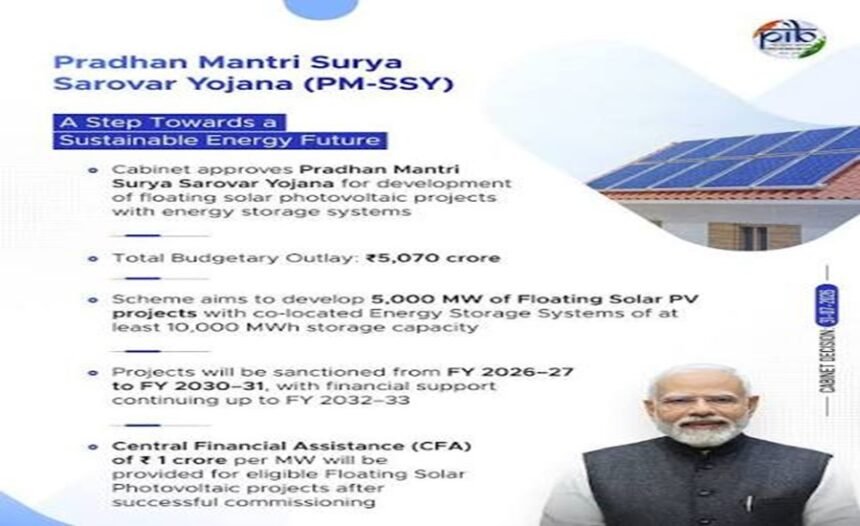
Floating solar power projects paired with battery storage has been approved by The Union Cabinet under a new scheme called the Pradhan Mantri Surya Sarovar Yojana. The total outlay comes to ₹5,070 crore. The goal is to add to India’s renewable energy capacity while putting the country’s reservoirs, ponds and other inland water bodies to use for clean power.
What the scheme actually builds
The plan calls for 5,000 MW of floating solar capacity, each project paired with energy storage systems holding at least 10,000 MWh, or about two hours’ worth of backup. Projects will be approved between FY 2026-27 and FY 2030-31, and the government will keep paying out financial support through FY 2032-33.
The scheme isn’t starting from guesswork. The National Institute of Solar Energy studied the country’s reservoirs and other suitable water bodies and put the total floating solar potential at around 102.18 GWp, so there’s plenty of room to grow beyond this first 5,000 MW target.
How the money is structured
Once a project is up and running, developers get Central Financial Assistance of ₹1 crore per MW. There’s also money set aside earlier in the process, up to ₹50 lakh per project, to cover feasibility work like bathymetry and hydrography studies, environmental checks, and other groundwork meant to catch problems before construction starts rather than after.
Where this leaves the country’s solar capacity
The scheme covers every state and union territory. If it plays out as planned, India’s floating solar capacity jumps from about 700 MW today to 5,700 MW. The appeal of floating solar is that it doesn’t compete with agriculture or housing for land, since panels sit on water that’s already being used for irrigation or industry. Add the storage systems, and the grid gets steadier power too, since stored energy can smooth out the dips when sunlight isn’t available.
The bigger payoff the government is pointing to
Officials estimate the scheme will cut roughly 10 million tonnes of CO2 emissions a year once fully rolled out. It’s also projected to create somewhere between 16,000 and 17,000 full-time equivalent jobs across the supply chain, from manufacturing to installation to maintenance.
There’s a manufacturing angle here too. The scheme is meant to give a push to domestic production of floatation systems, photovoltaic cells, solar modules and storage equipment, tying into the broader Aatmanirbhar Bharat push toward building more of this technology at home instead of importing it.
Key Takeaway: PM-SSY is a bet that reservoirs and ponds, currently just sitting there doing nothing for the power grid, can become a meaningful chunk of India’s renewable energy mix. By pairing the panels with storage, the scheme is trying to solve two problems at once: adding clean generation capacity and making that capacity more reliable once it’s on the grid. Between the emissions cuts, the job creation, and the push for local manufacturing, the government is framing this as one piece of a larger climate and energy strategy, one that leans on water bodies the country already has rather than land it would otherwise need to find.
MCQ’s :
1. The Pradhan Mantri Surya Sarovar Yojana (PM-SSY) primarily aims to promote:
A. Rooftop solar installations in urban areas
B. Floating solar power projects with battery energy storage
C. Offshore wind energy generation
D. Solar-powered irrigation pumps
2. According to the National Institute of Solar Energy (NISE), India’s estimated floating solar energy potential is approximately:
A. 52 GWp
B. 78 GWp
C. 102.18 GWp
D. 150 GWp