
India’s solar sector just picked up serious momentum with the government’s approval of the (PM) Pradhan Mantri Surya Sarovar Yojana (PM-SSY) on 31 July 2026. The plan calls for 5,000 MW of floating solar photovoltaic (FSPV) capacity, backed by co-located energy storage, so the country can add clean power without eating up more land. It carries a budget of ₹5,070 crore and runs from FY 2026–27 through FY 2030–31.
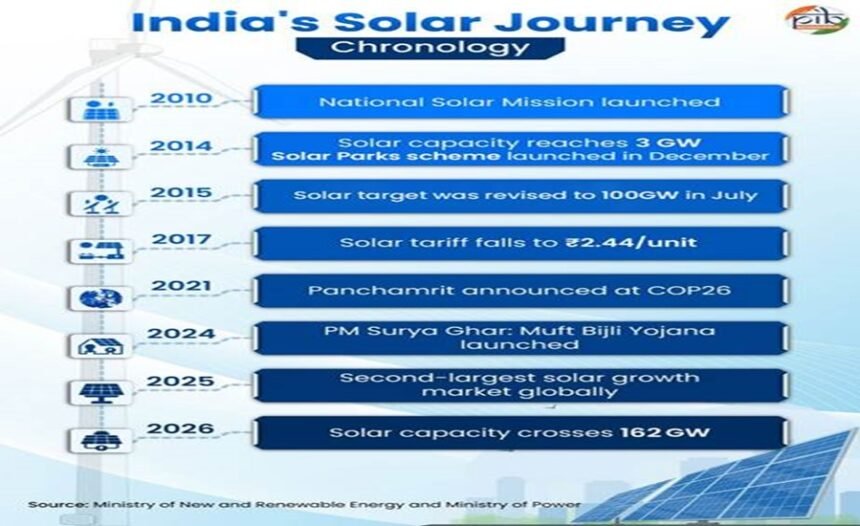
Solar has quietly become the engine of India’s renewable growth. In 2014, installed capacity sat around 3 GW. By 30 June 2026, that figure had grown past 162 GW, a more than fiftyfold increase, thanks to a mix of policy reform, infrastructure buildout, domestic manufacturing, and growing demand from households and businesses.
Inside the new floating solar plan
The scheme rests on findings from the National Institute of Solar Energy (NISE), which estimates India’s floating solar potential at roughly 102.18 GWp spread across reservoirs and inland water bodies. Beyond the 5,000 MW of panels, it includes 10,000 MWh of storage with a minimum two-hour duration, which should help states manage demand spikes more easily.
Building on reservoirs and industrial ponds keeps land use to a minimum while also improving how stable the grid stays. The government expects roughly 10 million tonnes of CO₂ emissions avoided each year, somewhere between 16,000 and 17,000 full-time jobs created, and a lift for local manufacturers making floats, PV cells, modules, and storage equipment. Floating solar capacity should rise from about 700 MW now to 5,700 MW under the scheme, and every state and union territory qualifies to participate.
Even before this scheme, 2025 was a strong year: India added 37 GW of solar capacity, overtaking the United States in annual additions and becoming the second-largest solar growth market in the world.
Years of policy work paying off
This didn’t come out of nowhere. The National Solar Mission, Solar Parks Scheme, Green Energy Corridor Programme, competitive bidding, Renewable Purchase Obligations, PM Surya Ghar: Muft Bijli Yojana, and PM-KUSUM have all fed into this growth over time. So far, 54 solar parks with a combined 39,188 MW have been approved under the Solar Parks Scheme, while the Green Energy Corridor has helped move 24,567.8 MW of renewable power through strengthened transmission lines. On manufacturing, the PLI scheme for high-efficiency PV modules and the ALMM framework have both worked to reduce dependence on imports.
FY 2025–26 by the numbers
Last fiscal year brought some notable milestones. Solar capacity additions reached 44.61 GW, nearly double the 23.83 GW added the year before. Module manufacturing capacity grew from just 2.3 GW in 2014 to around 172 GW by 31 March 2026. Total non-fossil fuel capacity reached 283.46 GW, of which 274.68 GW came from renewables, and the year added 55.29 GW of non-fossil capacity, the highest annual figure yet. On 29 July 2025, renewables supplied 51.5% of India’s electricity demand, the highest monthly share on record.
Rooftop and farm-level adoption
Rooftop solar has taken off through PM Surya Ghar: Muft Bijli Yojana, launched in February 2024. It’s now the largest household rooftop solar program in the world, with more than 43 lakh homes solarised and over 7.7 lakh households paying zero electricity bills as of June 2026. On farms, PM-KUSUM has enabled nearly 11.49 lakh off-grid solar pumps, solarised over 15.89 lakh agricultural pumps at the feeder level, added around 1,726 MW of decentralised solar capacity, and reached more than 21.77 lakh farmers since launching in 2019.
Key Takeaway: India has also worked to shape solar policy globally, co-founding the International Solar Alliance with France back in 2015 and launching One Sun One World One Grid with the UK at COP26. During its G20 presidency, India helped build agreement among member nations to triple global renewable capacity by 2030.
MCQ’s:
1. The Pradhan Mantri Surya Sarovar Yojana (PM-SSY), approved in 2026, primarily aims to:
(A) Promote rooftop solar systems in urban households
(B) Develop floating solar photovoltaic projects on reservoirs and inland water bodies
(C) Establish offshore wind farms along India’s coastline
(D) Expand nuclear power generation
2. Which of the following statements regarding the Pradhan Mantri Surya Sarovar Yojana (PM-SSY) is correct?
(A) It aims to install 5,000 MW of floating solar capacity with co-located energy storage.
(B) It is implemented exclusively in coastal states.
(C) It is funded by the Ministry of Jal Shakti.
(D) It is limited to rooftop solar installations.
Read more: Securing Bright Futures: Examination Reform Bill Fast-Tracks Justice Against Paper Leaks