
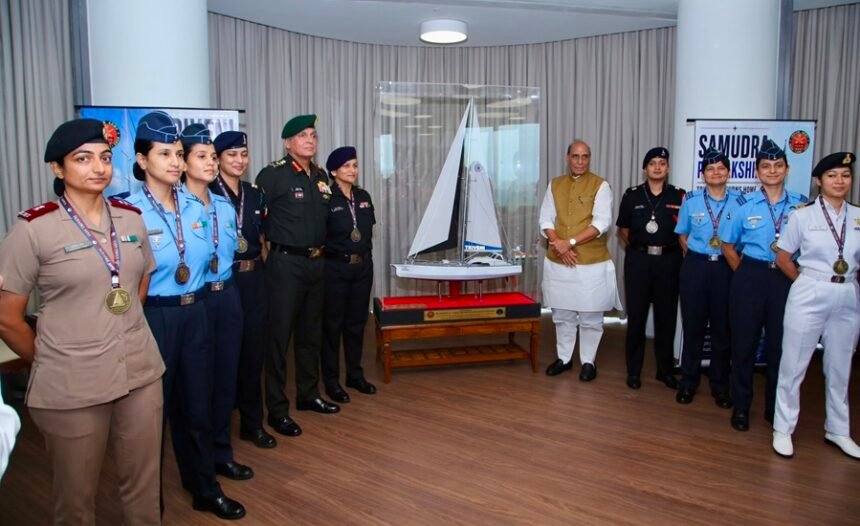
On July 30, 2026, Raksha Mantri Rajnath Singh felicitated the nine women officers from the three Services who had just returned from completing the first-ever Tri-service all-women circumnavigation sailing expedition, named ‘Samudra Pradakshina’, aboard the Indian Army Sailing Vessel (IASV) Triveni.
Meeting the officers in New Delhi, he praised their courage and determination in pulling off a 314-day voyage that covered nearly 25,500 nautical miles across four oceans. He called the expedition a testament to Nari Shakti and held it up as an outstanding example of Tri-service jointness and synergy, one that would inspire every Indian.
The Officers Share What Kept Them Going
The women officers talked with Rajnath Singh about their time at sea, noting that the sheer difficulty of the voyage is exactly what made it so memorable and worthwhile. What kept them pushing through the physical and mental strain, they said, was their determination to make the nation proud. Rajnath Singh responded that their dedication had inspired him personally and strengthened his own resolve, adding that their achievement shows what firm conviction and determination can accomplish.
Breaking Stereotypes on the High Seas
Rajnath Singh called the officers’ capability and confidence “incredible,” and said the successful completion of Samudra Pradakshina had shattered the stereotype that women cannot handle arduous military missions. “You have proven that physical capability, mental toughness, and leadership qualities are not bound by gender. Every daughter in India can look at you and believe that she, too, can cross oceans and conquer the world,” he told the officers.
A Showcase of Tri-Service Jointness
He described the expedition as a shining example of Tri-service jointness, pointing out that officers from the Indian Army, Indian Navy and Indian Air Force sailed together on one vessel, under one flag, working toward a shared mission. “The expedition is a testament to the fact that no horizon is too vast to conquer if we move forward together,” he said.
Rajnath Singh also praised the team for demonstrating India’s engineering excellence, indigenous capabilities and technological progress in every country they visited, telling them, “you conveyed a message to the world that India is second to none in any field.”
Senior Leadership Present at the Interaction
Chief of the Army Staff General Dhiraj Seth, Defence Secretary Rajesh Kumar Singh, Vice Chief of the Air Staff Air Marshal Ashutosh Dixit, Vice Chief of the Naval Staff Vice Admiral Ajay Kochhar, and other senior officers from all three Services were present for the interaction.
The IASV Triveni crew was virtually flagged in by Rajnath Singh on July 22, 2026, in Mumbai. Nearly a year earlier, he had joined the flag-off ceremony via video conferencing on September 11, 2025.
What It Took to Make the Voyage Happen
Pulling off the mission took meticulous planning, close to two years of intensive training, a shore-based support network running round the clock, and steady backing from numerous organisations and support agencies. The expedition met every internationally recognised criterion for a circumnavigation: crossing all meridians of longitude, crossing the Equator twice, crossing the International Date Line, and rounding the Three Great Capes, Cape Leeuwin, Cape Horn, and the Cape of Good Hope.
Getting through the notoriously difficult Drake Passage and rounding Cape Horn also earned the crew membership in the prestigious fraternity of Cape Horners, a distinction reserved for sailors who’ve conquered one of the toughest maritime passages on Earth.
More Than a Sailing Feat
Samudra Pradakshina wasn’t just a maritime achievement. It doubled as a form of military diplomacy. At each port call around the world, IASV Triveni gave a glimpse of India’s cultural heritage, maritime traditions, military professionalism and core values, building goodwill with friendly nations along the way.
Key Takeaway: The successful completion of Samudra Pradakshina aboard IASV Triveni marks a significant milestone for India’s armed forces, showcasing the growing role of women in demanding military operations and the strength of Tri-service integration.
Beyond fulfilling all internationally recognised criteria for a global circumnavigation, the expedition highlighted India’s indigenous capabilities, maritime expertise, and military professionalism while serving as an instrument of defence diplomacy by strengthening goodwill with partner nations. The mission stands as a symbol of India’s commitment to gender inclusion, jointness among the three Services, and an expanding global maritime presence.
M.C.Q.
Question 1: The expedition ‘Samudra Pradakshina’, which was in the news recently, was:
- A. India’s first all-women submarine mission
- B. The first Tri-service all-women circumnavigation sailing expedition aboard IASV Triveni
- C. A joint Indo-French naval exercise in the Indian Ocean
- D. An Antarctic scientific expedition undertaken by the Indian Navy
Question 2: To qualify as a recognised global circumnavigation, the crew of IASV Triveni rounded which of the following capes?
- A. Cape Comorin, Cape Cod and Cape York
- B. Cape Horn, Cape Leeuwin and Cape of Good Hope
- C. Cape Farewell, Cape Verde and Cape Agulhas
- D. Cape Wrath, Cape St. Vincent and Cape Byron
Read More: India’s Genetic Resources Board Sets A Remarkable New Roadmap