
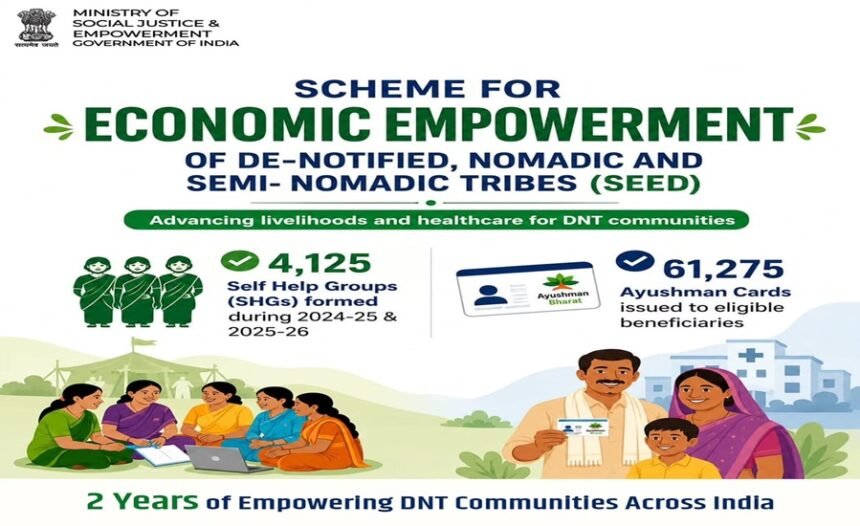
The Scheme for Economic Empowerment of De-notified, Nomadic and Semi-Nomadic Communities (SEED) is run by The Ministry of Social Justice and Empowerment, working with the Development and Welfare Board for De-notified, Nomadic and Semi-Nomadic Communities (DWBDNC). It’s aimed at improving education, healthcare, entrepreneurship, and livelihood access for these historically marginalised groups.
In 2025-26, the scheme reached more than 1.10 lakh beneficiaries across its components, backed by ₹53.06 crore released for education, healthcare, and livelihood work under the programme.
What SEED focuses on
The scheme works to build socio-economic security for Denotified Tribes, Nomadic Tribes, and Semi-Nomadic Tribes through a handful of interventions: educational support and scholarships, healthcare assistance, entrepreneurship promotion, livelihood generation, and skill development tied to self-employment.
The logic behind covering so many fronts at once is simple. Deprivation for these communities has never been just one problem, so the programme doesn’t treat it like one, it’s trying to move the needle on long-term economic security and social inclusion together.
Education and entrepreneurship on the ground
The Ministry says the scheme is improving education access and helping beneficiaries pursue both professional and academic goals. It’s also backing entrepreneurship and sustainable livelihoods in different parts of the country. Beneficiaries have put the support toward expanding their businesses, growing household income, and building more financial cushion.
A step toward inclusive growth
Sudhansh Pant, Secretary at the Ministry of Social Justice and Empowerment, said SEED is helping DNT, NT, and SNT families take a more active part in India’s development. He pointed to progress in education, business, and careers as evidence the scheme is opening real doors, not just distributing funds.
Key Takeaway: Success stories are turning up in more places as the scheme’s combined approach to education, healthcare, entrepreneurship, and livelihoods plays out. They’re a sign of what the government is aiming for: better opportunities for Denotified, Nomadic, and Semi-Nomadic communities through policy that actually reaches them. SEED remains one of the government’s central tools for expanding opportunity and pushing inclusive development further across the country.
MCQ:
1. The SEED Scheme launched by the Government of India primarily targets which of the following communities?
A. Scheduled Tribes living in forest areas
B. De-notified, Nomadic and Semi-Nomadic Communities
C. Particularly Vulnerable Tribal Groups (PVTGs)
D. Urban migrant workers
2. The Scheme for Economic Empowerment of De-notified, Nomadic and Semi-Nomadic Communities (SEED) is implemented by which Union Ministry?
A. Ministry of Tribal Affairs
B. Ministry of Rural Development
C. Ministry of Social Justice and Empowerment
D. Ministry of Minority Affairs
Read more: Massive Boost: ₹25,863 Crore Released Under VB-G-RAM-G Scheme