

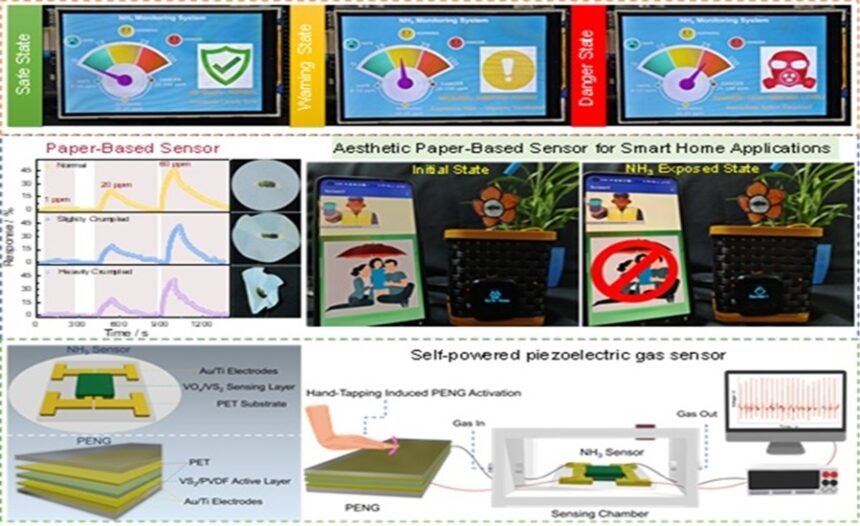
A gas sensing platform that can pick up ammonia at very low concentrations without needing to be heated up first has been built by Researchers at the Centre for Nano and Soft Matter Sciences (CeNS), Bengaluru, an autonomous institute under the Department of Science and Technology, have built The goal is straightforward: get this into portable, wearable, self-powered devices that can flag dangerous ammonia levels before they become a health problem.
Why Ammonia Detection Matters
Ammonia shows up everywhere in industry, fertilizer plants, refrigeration units, chemical manufacturing, agriculture. Accidental exposure irritates eyes, skin and the respiratory tract, and if it goes on long enough, the health effects get more serious. That’s the case for continuous monitoring in the first place.
How the Sensor Works
The team built their sensor around a hybrid vanadium oxide-vanadium sulfide (VOx/VS₂) heterostructure. They engineered the material through a controlled surface transformation, which opened up plenty of active sites for ammonia molecules to stick to and improved how charge moves through the sensing layer. The result is fast, selective detection at ambient temperature, no heating element required.
In testing, the sensor picked up ammonia at concentrations as low as 319 parts per billion, comfortably under occupational safety thresholds. It stayed selective against other common gases, held up over repeated use, kept working reliably for more than ten weeks, and performed well across a wide range of concentrations. Most conventional gas sensors need high operating temperatures or some kind of external activation to work. This one doesn’t, which cuts down on energy use and makes it easier to actually deploy.
From Lab Material to Working Prototype
The team, led by Prof. Angappane Subramanian with Dr. Vishnu G. Nath, Ankur Verma, Abhijit Paul and Dr. Subash Cherumannil Karumuthil, took the sensing material and turned it into real devices. One is a portable monitor that triggers an alert once ammonia levels cross a set threshold, sorting conditions into safe, warning and danger zones. That kind of setup fits naturally into industrial facilities, labs, storage units and farms.
They also paired the sensor with a flexible piezoelectric nanogenerator, so the whole device can run on mechanical energy harvested from human movement, no external power source needed. Flexible versions built on polymer, paper and textile substrates kept working even when bent, twisted or folded. To show what that could look like in practice, the team built prototype smart bands, smart-home warning systems and electronic textile platforms.
Key Takeaway: CeNS Bengaluru has developed a room-temperature ammonia sensor sensitive enough to detect concentrations as low as 319 ppb, with self-powered and wearable prototypes already built and tested, offering a practical path toward safer industrial and environmental monitoring.
MCQ’s:
1. The sensor is based on which heterostructure?
A. Graphene–Silicon
B. Zinc Oxide–Titanium Oxide
C. Vanadium Oxide–Vanadium Sulfide (VOx/VS₂)
D. Copper Oxide–Graphene
2. The newly developed sensor can detect ammonia concentrations as low as:
A. 10 ppm
B. 1 ppm
C. 319 parts per billion (ppb)
D. 500 ppb
Read more: Jal Jeevan Mission 2.0 – Reform Linked MoUs Signed with Manipur and Bihar