
NITI Aayog has rolled out a new tool called the Investment Friendliness Index (IFI), built to measure how well states and Union Territories are setting up conditions that attract investment. The report looks at policy, regulation, institutions, and infrastructure, using data to push states toward reform and a bit of healthy competition with each other.
The idea traces back to July 2024, when the Prime Minister asked, during the 9th Governing Council Meeting of NITI Aayog, for an Investment-Friendly Charter to be developed. The Union Budget 2025–26 later named it as a reform meant to strengthen cooperative and competitive federalism and sharpen India’s investment climate.
Why states matter here
The Centre sets the broader policy and macroeconomic backdrop, but states are the ones actually attracting investment day to day, through governance, infrastructure, clear rules, and policies that don’t keep shifting. The IFI benchmarks exactly these factors, so states can see where they stand, where the gaps are, and what’s working elsewhere. All of this feeds into the larger Viksit Bharat @2047 goal.
Eight pillars, 84 indicators
The index covers all 28 states and 8 Union Territories across eight areas:
Infrastructure, Business Climate, Resources, Government Policy, Regulatory Ease, Institutional Environment, Financial Health, and Environmental Resilience.
These are built from 84 indicators, mixing secondary data with investor perception surveys, so the picture is both quantitative and grounded in what investors actually experience on the ground.
Four performance bands
States and UTs fall into four groups based on their scores:
- Top Performers – above 50
- Frontrunners – 45 to 50
- Emerging Performers – 40 to below 45
- Aspiring States – below 40
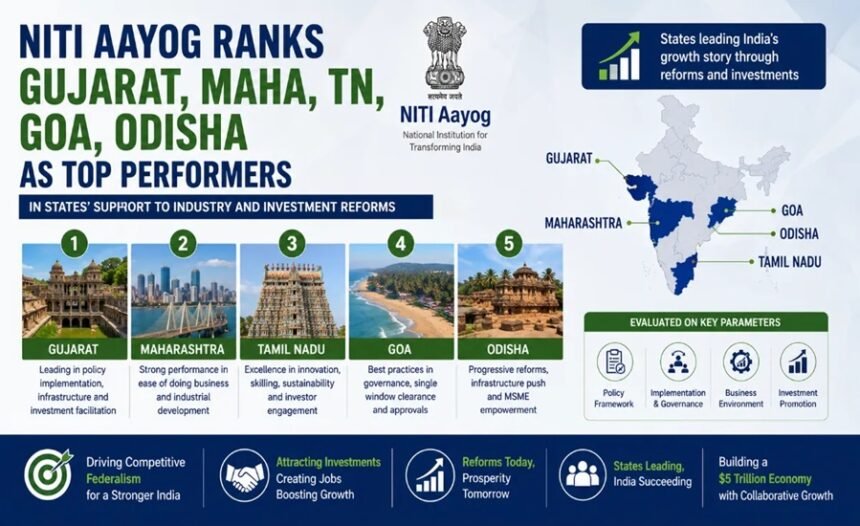
Gujarat, Maharashtra, Tamil Nadu, Goa, and Odisha landed in the Top Performers group. Fifteen states made it into Frontrunners, and the rest fall under Emerging Performers or Aspiring States.
Rankings within peer groups
Since comparing a small UT to a large state doesn’t tell you much, the report splits jurisdictions into three peer groups: Large States, Hilly and North-Eastern States, and Union Territories and City States.
Gujarat topped the Large States list, with Maharashtra and Tamil Nadu behind it. Uttarakhand led the Hilly and North-Eastern States, ahead of Assam and Himachal Pradesh. Among Union Territories and City States, Goa came first, followed by Delhi and Chandigarh.
State profiles
Every state and UT gets its own detailed profile covering all eight pillars, benchmarked against peers, with problem areas flagged and investor feedback folded in. The goal is to give policymakers something concrete to act on and give investors a clearer read on where opportunities actually lie.
Key Takeaway: NITI Aayog frames this as more than a one-time ranking. It’s meant to work as an ongoing reform tool, with the Centre, states, industry, and other stakeholders continuing to shape it over time, pushing states toward more transparency, steadier policy, and simpler regulation, so India stays competitive as an investment destination while growth stays broad-based.
MCQ:
1. The Investment Friendliness Index (IFI), recently launched by NITI Aayog, evaluates States and Union Territories across how many pillars?
A. 6
B. 7
C. 8
D. 10
2. Which of the following States topped the Large States category in the first edition of the Investment Friendliness Index (IFI)?
A. Maharashtra
B. Tamil Nadu
C. Gujarat
D. Karnataka
Read more: Shobha Karandlaje Showcases Hyderabad’s Revolutionary AI Power to BRICS-India’s Tech Leadership