
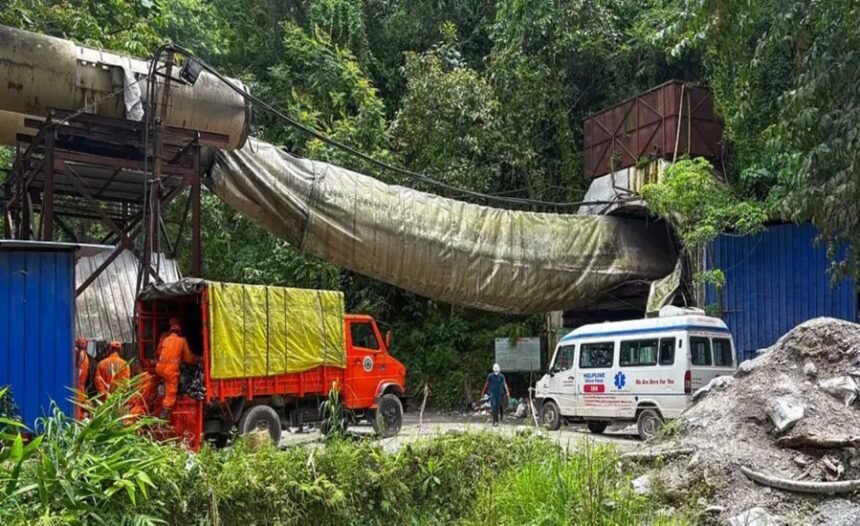
On July 20, 2026, an under-construction Head Race Tunnel (HRT) at NHPC’s 500 MW Teesta Stage VI Hydropower Project in Samardung, in Sikkim’s Namchi district, turned into a death trap. A sudden, explosive release of suspected methane trapped in the surrounding rock generated toxic gases that killed 20 workers, at least as far as reports go so far. Five more workers were still stuck about 1.5 km inside the tunnel when the incident was reported. It’s a grim reminder of just how dangerous building infrastructure in the Himalayas can be.
Piecing Together What Went Wrong
NHPC says it will investigate the incident thoroughly, and the Sikkim government has set up its own high-level committee to look into the matter. What preliminary findings point to is this: toxic gases built up in the HRT after suspected methane, trapped inside the rock, was suddenly released.
That triggered an explosion and partially damaged the tunnel. In other words, workers likely struck gas-bearing rock while drilling or building the tunnel, which happens to be one of the most critical parts of any hydropower plant. It’s the structure that carries huge volumes of water from the reservoir’s intake point to the turbines that actually generate power.
NHPC officials note that tunnel projects across India, and especially those in the fragile Himalayan belt, go through surveys at every stage: planning, construction, and maintenance. These usually include topographical, geotechnical, geophysical, hydrological, resistivity, and utility tests, all meant to protect structural stability, worker safety, and environmental compliance. But here’s the catch: none of these tests can actually detect methane. The gas is colourless, odourless, and highly flammable, and it only takes the right mix with air plus an ignition source, quite possibly a spark thrown up during drilling, to set off an explosion like the one at Teesta-VI.
How Does Methane End Up Trapped in Hills?
Methane usually shows up in hilly terrain in one of two ways: as natural gas locked inside porous rock, or as localised pockets in younger, more unstable geological formations. You’ll find this often in the Himalayan belt and other mountain regions that sit on coal-bearing strata, where organic matter has been breaking down for millions of years.
Valleys and depressions in hilly areas also tend to trap moisture, which creates oxygen-starved, waterlogged soil. Microorganisms feast on the organic matter in these anaerobic conditions and release methane as a byproduct. Poorly managed waste dumps in hilly regions do something similar, decomposing in low-oxygen layers and generating large volumes of landfill gas.
There’s also the geology to consider. Mountainous regions often sit close to fault lines or above coal, gas, or geothermal reserves, and natural fissures let underground methane migrate upward over time. Sikkim itself has no coalfields, but it falls within the Rangit Tectonic Window zone. Geological Survey of India studies have found roughly 1.40 lakh tonnes of coal reserves in southern Sikkim, concentrated mainly around Namchi, which is exactly where the tunnel incident happened.
According to Sikkim’s Mines and Geology Department, a regional coal exploration project began in the district in December 2025, part of a broader Government of India programme. Tests on the coal found in Namchi showed 53.40% fixed carbon, 39.5% ash, 3.4% volatile matter, and 3.7% moisture.
A Fragile Landscape With a History of Disasters
The Himalayas are geologically young, tectonically restless, and prone to erosion, which makes them fragile in ways older mountain ranges simply aren’t. The land here is still rising and shifting because of the ongoing collision between the Indian and Eurasian plates, and that constant movement makes the region especially earthquake-prone.
Add heavy blasting and tunnelling for highways, dams, and railways, and you get even more instability, along with frequent landslides and mudslides. Unregulated tourism, unchecked urban growth, poor waste management, and deforestation only make things worse.
Sikkim has also seen its share of extreme weather tied to climate change, from cloudbursts to fast-melting glaciers to swelling glacial lakes. Hydropower projects in the state have taken a direct hit from these forces more than once. In October 2023, a Glacial Lake Outburst Flood killed more than 90 people and wiped out Sikkim Urja Limited’s 1,200 MW dam at Chungthang in Mangan district.
That same flood damaged NHPC’s 510 MW Teesta-V Hydropower Project, which took three years to bring back online. Then in August 2024, a landslip damaged some houses and a building at that same project. The Teesta-VI tunnel disaster, though, is different: it’s the first time an explosion caused by suspected methane release has been recorded in the state.
Tunnelling’s Troubled Track Record Across India
Tunnelling has never been a low-risk business in India, particularly across the fragile Himalayan system and its eastern reach into the hills of Mizoram. Several of the past incidents involved NHPC’s own hydropower projects. In May 2021, a large section of an under-construction diversion tunnel at the 800 MW Parbati-II Project in Himachal Pradesh collapsed, killing four labourers. In June 2022, part of a tunnel roof gave way at the 2,000 MW Subansiri Lower Hydroelectric Project on the Arunachal Pradesh-Assam border, killing one worker.
A similar cave-in at the same site claimed another life in July 2024. In August 2025, torrential rain caused a massive landslip at NHPC’s Dhauliganga Hydroelectric Project in Uttarakhand’s Pithoragarh district, though this time there was some good news: all 19 trapped NHPC employees were rescued.
It isn’t only NHPC projects that have run into trouble. The twin-tube Khooni Nallah tunnel, built by private firms for the National Highways Authority of India on the Jammu-Srinagar highway, saw a disaster in May 2022 that killed 10 workers. Just a year later, in November 2023, 41 workers trapped in a caved-in section of the under-construction Silkyara Bend-Barkot tunnel were successfully rescued; that project was being executed through contractors by the National Highways and Infrastructure Development Corporation Limited.
Then there’s the Srisailam Left Bank Canal tunnel collapse in February 2025, which trapped eight engineers and labourers. Only two bodies were recovered, and the rest are presumed dead. But the worst of them all came in Manipur in June 2022, when a massive landslip struck the construction site of the Tupul Railway Station, killing 61 people. That station is tied to multiple tunnels and is part of the 111-km Jiribam-Imphal railway project, currently being executed by the Northeast Frontier Railway.
Officials from the Railways, NHAI, NHIDCL, and NHPC all point to the same underlying reason for building through such dangerous terrain: New Delhi wants to connect even the most remote villages along the country’s international borders, and in the northeast, that means tunnels are simply unavoidable.
Key Takeaway: The NHPC Teesta Stage VI tunnel disaster underscores the unique engineering and safety challenges of infrastructure development in the geologically young and tectonically active Himalayas, where conventional geological surveys may not detect hidden hazards such as methane pockets.
Beyond highlighting the need for stronger risk assessment, advanced gas detection systems, and stricter worker safety protocols during tunnelling, the incident also draws attention to the broader challenge of balancing strategic infrastructure expansion in India’s border regions with environmental fragility and disaster resilience.
Set against a backdrop of recurring landslides, floods, tunnel collapses, and climate-linked disasters, the tragedy reinforces the importance of integrating geological, environmental, and technological safeguards into the planning and execution of hydropower and connectivity projects across the Himalayan region.
M.C.Q.
Question 1: The Head Race Tunnel (HRT), frequently seen in hydropower projects, primarily performs which of the following functions?
- A. Stores excess electricity generated by turbines
- B. Carries water from the reservoir/intake to the turbines for power generation
- C. Diverts floodwater away from the dam
- D. Supplies drinking water to nearby settlements
Question 2: Which of the following best explains why the Himalayan region is highly prone to landslides and tunnelling hazards?
- A. The Himalayas are among the oldest and most stable mountain systems in the world.
- B. The Himalayas are geologically young and continue to rise due to the ongoing collision of the Indian and Eurasian plates.
- C. The Himalayas experience no tectonic activity but receive excessive rainfall.
- D. The Himalayas are entirely volcanic in origin.
Read More: Is India Really Prepared To Face A Terrific Challenge of An Internet Blackout?