
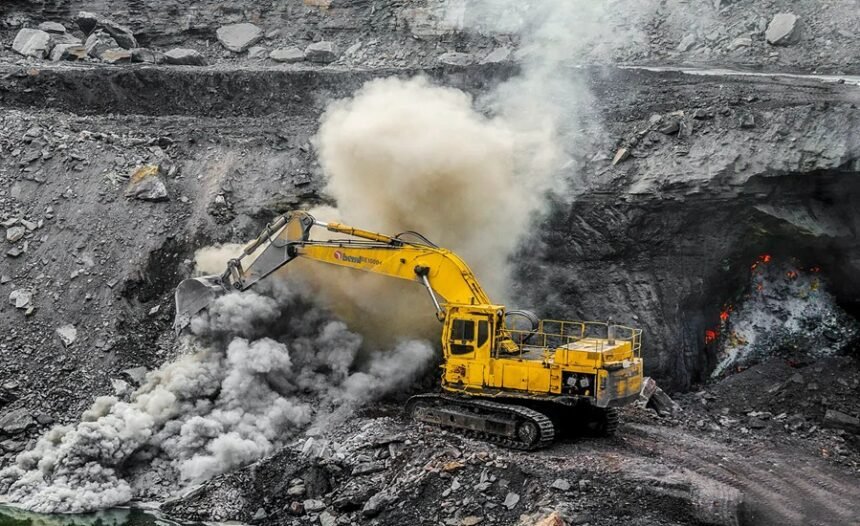
Over the past five years, the government has pushed through a wave of structural and procedural changes to make coal allocation and mining more transparent, efficient and scientifically driven. The central shift has been moving away from allotment toward allocation through open, competitive auctions, paired with the opening up of commercial coal mining in 2020, with no restrictions on how the coal is sold or used.
Moving toward market-based allocation
Commercial coal mining was thrown open with no technical or financial eligibility conditions attached, and 100% Foreign Direct Investment is now permitted through the automatic route. Auctions themselves have shifted to a percentage revenue-share model, with the National Coal Index brought in to keep pricing transparent and tied to the market.
A Single Window Mode Agnostic (SWMA) Auction system was introduced to sell all of Coal India Limited’s non-linkage coal through one single channel, cutting out market distortions and levelling the playing field for buyers. The SHAKTI policy has also been simplified into two windows, Window I at the Notified Price and Window II at a premium above it, giving existing linkage consumers the ability to procure up to their full Plant Load Factor requirement.
On top of that, a CoalSETU window has been added under the Non-Regulated Sector Linkage Auction Policy, offering auction-based linkages with no end-use restrictions at all, so buyers have full flexibility for self-consumption, coal washing or export.
Making it easier to do business
A Single Window Clearance System has gone live through the PARIVESH 2.0 portal, speeding up how quickly new mines can start operating. On exploration, 44 private entities have been notified as Accredited Prospecting Agencies, eliminating the need for a separate prospecting licence, and the process for approving Geological Reports has also been made simpler.
Several statutory changes have followed too. The Colliery Control Rules were amended to let coal company boards themselves grant Mine Opening Permissions. Coking Coal has been designated a Critical and Strategic Mineral under the MMDR Act, 1957, which speeds up environmental and forest clearances for coking coal projects. The government has also brought in the Mine Developer and Operator (MDO) model for coal mining, and closed or abandoned mines are now being offered under a revenue-sharing arrangement to extract whatever value remains in them.
On the financial side, Insurance Surety Bonds are now an accepted way to furnish performance security in Coal Block Development and Production Agreements, cutting reliance on bank guarantees, freeing up working capital that would otherwise sit locked, and opening the door to wider participation.
Modernising the sector with technology
Under ‘Mission Coking Coal’, the government is targeting an increase in the country’s coal washery capacity to 58 million tonnes by FY 2030. On the monitoring front, the Ministry of Coal has rolled out the Koyla Shakti Dashboard, giving real-time visibility into coal production, coal mining, dispatch, stock levels and transportation.
The Khanan Prahari mobile app and the CMSMS web app have also been deployed nationwide, letting citizens report unauthorised mining activity directly. CIL, for its part, has set up Integrated Command and Control Centres equipped with AI-based video analytics, RFID-enabled weighbridges, GPS vehicle tracking, and drone or satellite mapping to support more scientific mine planning.
On the gasification front, the government has approved two major schemes, one worth ₹8,500 crore (already backing 8 approved projects) and another worth ₹37,500 crore, both aimed at hitting a target of 100 million tonnes of gasification capacity by 2030. CIL has also mapped out a phased renewable energy plan, targeting 3 GW of net-zero renewable capacity by FY 2027-28 and 9.5 GW by FY 2029-30, with 558 MW already installed across utility-scale and captive projects. Through all of this, coal remains a critical piece of India’s energy security and industrial growth.
Environmental measures and cleaner mining
The government has also been pushing environmental sustainability in mining through plantation and bio-reclamation efforts, the development of eco-parks, and better use of mine water. Blast-free mining approaches, Surface Miners in particular, are increasingly replacing conventional drilling methods.
Production numbers and logistics upgrades
India’s domestic coal production has climbed sharply, from around 731 million tonnes in 2019-20 to crossing the 1 billion tonne mark for two years running, hitting 1,047.52 MT in FY 2024-25 and 1,039 MT in FY 2025-26.
To move all this coal efficiently, the government has launched an Integrated Coal Logistics Plan, aiming to build a technology-driven, cost-effective multimodal logistics network spanning rail, road, coastal shipping and inland waterways. So far, 139 First Mile Connectivity projects with a combined capacity of about 1,319 million tonnes have been taken up, and of these, 72 projects representing roughly 589 million tonnes capacity have already been commissioned.
A new platform for trading coal
To bring further order to the sector, the government has notified the Coal Exchange Rules, 2026, setting up a regulated online platform for trading coal and its processed forms. This Coal Exchange will let both captive and commercial miners, along with consumers, enter into delivery-based contracts directly.
Key Takeaway: The coal sector reforms undertaken over the past five years mark a comprehensive shift towards a more transparent, competitive, and technology-driven mining ecosystem through commercial coal mining, market-based auctions, simplified clearances, digital governance, and regulatory reforms.
Alongside record domestic coal production exceeding 1 billion tonnes for two consecutive years, the government has strengthened energy security through logistics upgrades, coal gasification initiatives, renewable energy integration, environmental sustainability measures, and the introduction of the Coal Exchange Rules, 2026, positioning the sector to support India’s growing energy demand while improving efficiency, attracting investment, and advancing the long-term goals of industrial growth and cleaner resource utilisation.
M.C.Q.
Question 1: Under India’s coal sector reforms, 100% Foreign Direct Investment (FDI) in commercial coal mining is permitted through which route?
- A. Government Route
- B. Automatic Route
- C. Approval of NITI Aayog
- D. Competitive Bidding Route
Question 2: The Coal Exchange Rules, 2026 were notified primarily to:
- A. Regulate coal imports into India.
- B. Establish a regulated online platform for trading coal and its processed forms.
- C. Fix the retail price of coal across the country.
- D. Nationalise all private coal mines.
Read More: Gaganyaan’s Mammoth Progress Towards Human Spaceflight