
India’s move toward digital education has a major driving force behind it: the Digital Infrastructure for Knowledge Sharing (DIKSHA) platform. Launched in 2017 under the Ministry of Education’s PM e-Vidya initiative, DIKSHA has grown into the country’s flagship digital learning platform, delivering curriculum-linked content to millions of students and teachers across India. Built by the National Council of Educational Research and Training (NCERT) along with the Central Institute of Educational Technology (CIET), DIKSHA is often called India’s “One Nation, One Digital Platform” for school education.
A national learning ecosystem, built to scale
DIKSHA was designed from the start as open-source and scalable, capable of handling the wildly different educational needs across India’s states and union territories. It covers the full K-12 range, everything from foundational literacy and numeracy through to senior secondary.
Because of its flexible architecture, education boards can customise content to match local curricula, languages and teaching methods.
That flexibility is a big part of why it’s become so widely adopted. The broader aim is a technology-enabled learning ecosystem that’s accessible, personalised and engaging, one that supports what the National Education Policy (NEP) 2020 set out to achieve.
More than just textbooks
What sets DIKSHA apart is its library of interactive content built to make learning feel less like a lecture and more like an experience.
The platform offers:
- 2D and 3D animations
- Augmented Reality (AR) experiences
- Simulations and virtual experiments
- Virtual laboratories
- Interactive quizzes and assessments
- Sign language learning videos
One notable innovation is the QR-coded Energised Textbook. Scan the code on a printed NCERT textbook and it connects you straight to videos, digital resources, teacher guides and other interactive material.
For students with disabilities, there are accessibility features including:
- DAISY (Digital Accessible Information System) formats
- Text-to-speech functionality
- Indian Sign Language (ISL) videos
The point is inclusive learning, not learning for some students and an afterthought for others.
Personalised learning, and support for teachers too
DIKSHA leans into competency-based learning, offering unlimited practice questions, detailed explanations, adaptive assessments and question banks that help spot where students are falling behind so gaps can be addressed early. Teachers get their own piece of the platform. Through programmes like NISHTHA and various state-specific Teacher Professional Development (TPD) initiatives, educators can take self-paced certification courses and training modules.
Content creation, delivery, assessment and analytics all sit within the same system, which supports a more evidence-based approach to teaching.
A federated system built for local relevance
DIKSHA runs on a federated architecture, meaning states, institutions and organisations can create and manage their own educational content in regional languages, independently.
This decentralised setup allows for:
- Curriculum alignment with state education boards
- Regional language content creation
- Local pedagogical adaptation
- Continuous content updates
CIET-NCERT periodically validates all uploaded content to keep quality consistent, and contributors are encouraged to keep materials age-appropriate and grade-appropriate, in local languages wherever possible.
Working around patchy internet access
DIKSHA was built with the digital divide in mind, so it supports both online and offline learning. Students and teachers can download content for offline use, and many states preload material onto Smart Class devices so classrooms in low-connectivity areas aren’t left out.
In line with NEP 2020, NCERT has translated textbooks for Classes 1, 2, 3 and 6 into all 22 scheduled Indian languages, and these are available digitally through DIKSHA and NCERT’s own platforms.
Altogether, DIKSHA supports content in 135 languages, 128 of them Indian and seven foreign, putting it among the largest multilingual learning platforms anywhere in the world.
Everything in one place
DIKSHA brings together a wide range of tools under one roof, including:
- Energised Textbooks
- Question Banks
- Digital Credentials and Certificates
- Teacher Professional Development modules
- Content Authoring tools
- Quizzes and Surveys
- Learning Dashboards and Analytics
- Mentoring and Collaboration features
- Chatbots
- Language Translation tools
- Digital Registries and Credential Systems
It also supports “phygital” learning, a hybrid mix of classroom teaching and digital resources.
The numbers, as of June 27, 2026
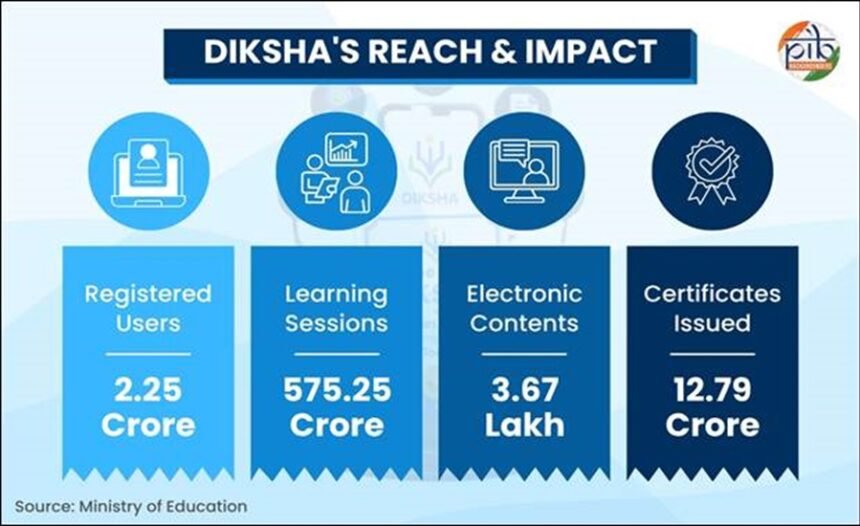
Users: around 3 lakh daily active users, more than 2.25 crore registered overall.
Engagement: over 575 crore learning sessions, and more than 6,691 crore learning minutes logged.
Content: 7,687 Energised Textbooks and over 3.67 lakh digital learning resources.
Courses: 18.77 crore enrolments, 14.82 crore completions, 12.79 crore certificates issued, across 347 available courses.
Uttar Pradesh, Gujarat, Bihar, Rajasthan and Maharashtra lead the way in registered users.
Investing in teachers, not just students
DIKSHA’s reach goes beyond students. Over 614 virtual laboratories have been built to push inquiry-based, creative learning, and 50 faculty members from State Councils and District Institutes have been trained specifically to develop teacher training content. Professional development runs through an integrated Learning Management System (LMS).
Key Takeaway: As India keeps building out its digital education infrastructure, DIKSHA has turned into one of its central pillars. By working around geography, expanding language access and pushing personalised learning, it’s helping put quality education within reach for more people. Its continued growth reflects a broader bet India is making: that technology, used well, can make learning more inclusive and more equitable, for every student and teacher trying to be part of that shift.
MCQs:
1. DIKSHA stands for:
A) Digital India Knowledge and School Hub for Academics
B) Digital Infrastructure for Knowledge Sharing
C) Digital Integrated Knowledge Sharing Hub for Academics
D) Digital Information and Knowledge Sharing Architecture
2. DIKSHA was launched in:
A) 2015
B) 2016
C) 2017
D) 2020
Read more: How Sagarmala is Beautifully Revolutionizing India’s Maritime Sector