
The Department of Drinking Water and Sanitation (DDWS), under the Ministry of Jal Shakti, has signed reform-linked Memoranda of Understanding with the Governments of Manipur and Bihar as part of Jal Jeevan Mission (JJM) 2.0. The agreements push for a Gram Panchayat-led model of rural water governance, one built around community participation and long-term accountability rather than just laying pipes, with an eye toward the broader Viksit Bharat @2047 goals.
A Shift Toward Panchayat-Led Governance
The MoUs call for a service-based, community-centred approach to water delivery. Every rural household should get an adequate, quality supply of drinking water, and the plan leans on Jan Bhagidari (public participation), better operation and maintenance of existing systems, and institutional reforms meant to hold up over the long run.
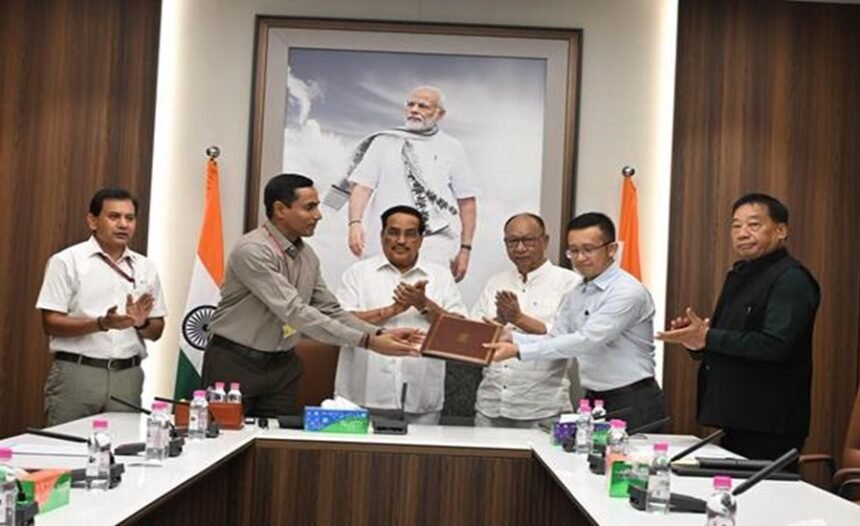
The Manipur MoU was signed with Union Minister of Jal Shakti C. R. Patil and Manipur Chief Minister Yumnam Khemchand Singh present. The Bihar MoU followed at a separate meeting, attended by Patil, Minister of State Dr. Raj Bhushan Choudhary, and Bihar’s Public Health Engineering Minister Sanjay Kumar Singh. Senior DDWS officials were on hand too: Secretary Ashok K. K. Meena, Mission Director Kamal Kishore Soan, and Joint Secretary D. Senthil Pandiyan.
Pandiyan exchanged the Manipur agreement with Dr. Neilinthang Teilien, Secretary to the Chief Minister of Manipur. For Bihar, he exchanged it with Rajesh Kumar, Principal Secretary of the state’s Public Health Engineering Department.
What Officials Said
Patil credited the Jal Jeevan Mission, launched under Prime Minister Narendra Modi, with changing how rural India accesses drinking water and easing the burden of fetching it, a task that has fallen disproportionately on women and girls. With JJM 2.0, he said, the focus moves toward sustaining that infrastructure: keeping tap connections functional, improving water quality, protecting sources, strengthening operation and maintenance, and getting communities more involved in monitoring.
He also pushed for water conservation, rainwater harvesting, groundwater recharge, and catchment protection, funded through Finance Commission grants and VB-G RAM G funds, alongside stronger water quality monitoring at the Gram Panchayat and district level.
On Manipur, Patil said he expects the state to finish its remaining household tap connections and reach full rural coverage despite tough terrain. On Bihar, which has already crossed 90 percent rural tap water coverage, he asked the state to shore up its operation and maintenance systems and finish what’s left, tying its progress to the idea of Viksit Bharat—Viksit Bihar.
Chief Minister Yumnam Khemchand Singh described the MoU as a move away from pure infrastructure building and toward sustainable service delivery, through digital monitoring, policy reform, and community involvement. He reaffirmed Manipur’s commitment to the reform agenda.
Bihar’s Sanjay Kumar Singh pointed out that the state had actually started its own Har Ghar Nal Ka Jal programme back in 2016, ahead of the national mission. Central support, he said, has helped Bihar keep expanding rural water infrastructure despite geographic and economic hurdles.
Key Takeaway: Secretary Meena stressed that the MoUs are about decentralised governance, not just building things. That means empowering Gram Panchayats and Village Water and Sanitation Committees, holding regular District Water and Sanitation Mission meetings, drawing up Village Action Plans, and tightening district-level monitoring, all in service of the “Har Ghar Nirantar Nal Se Jal” goal.
Mission Director Soan added that JJM 2.0 isn’t just about tap connections. It’s about keeping safe water flowing reliably for the next 25 to 30 years, and he reaffirmed the central government’s commitment to helping Manipur with technical support and capacity building.
With these two agreements, 33 of the 34 states and union territories under JJM 2.0 have now signed reform-linked MoUs with the DDWS.
MCQ’s:
1. According to the MoUs, every rural household should receive:
A. Free irrigation water
B. Adequate and quality drinking water supply
C. Free bottled drinking water
D. Water only during summer months
2. Which Union Minister was present during the signing of both reform-linked MoUs?
A. Shivraj Singh Chouhan
B. C. R. Patil
C. Nitin Gadkari
D. Dharmendra Pradhan
Read more: Sangeet Natak Akademi Fellowship & Awards 2024-2025