

India’s space sector is picking up real momentum, and Skyroot Aerospace is at the center of it with Vikram-1, the country’s first privately built orbital launch vehicle. Much of this shift traces back to the Indian Space Policy 2023, which opened up the whole space value chain to private companies. Now firms are involved in satellite manufacturing, launch services, space applications, and downstream services across the industry.
The numbers show how fast things have moved: India had just one space startup in 2014. By 2026, that number has passed 400. The space economy is currently worth about $8.4 billion. Projections put it at $40–45 billion by 2030, with a longer-term target of $100 billion by 2040, backed by government support, regulatory changes, and public-private partnerships.
Vikram-1 and Mission Aagaman
Vikram-1 can carry 350 kilograms to Low Earth Orbit. It’s built with an all-carbon composite structure, solid-fuel boosters, and a 3D-printed liquid engine. The launch, called Mission Aagaman, is set for sometime between July 12 and August 4, 2026, and a successful flight would be a strong signal that India’s commercial launch reforms are working.
The rocket will drop several payloads into a 450-kilometre orbit:
- Skyroot’s own SCOPE satellite
- A tech demo payload from DCUBED
- Grahaa Space’s SOLARAS S3 satellite
- Embrace, a robotic arm from Cosmoserve Space built to grab orbital debris
There are also two symbolic items on board: “Cosmic Bloom,” a flower-shaped artwork, and an 18-karat gold micro-rocket carrying tiny sculpted likenesses of C. V. Raman, Vikram Sarabhai, and A. P. J. Abdul Kalam.
The reforms behind the growth
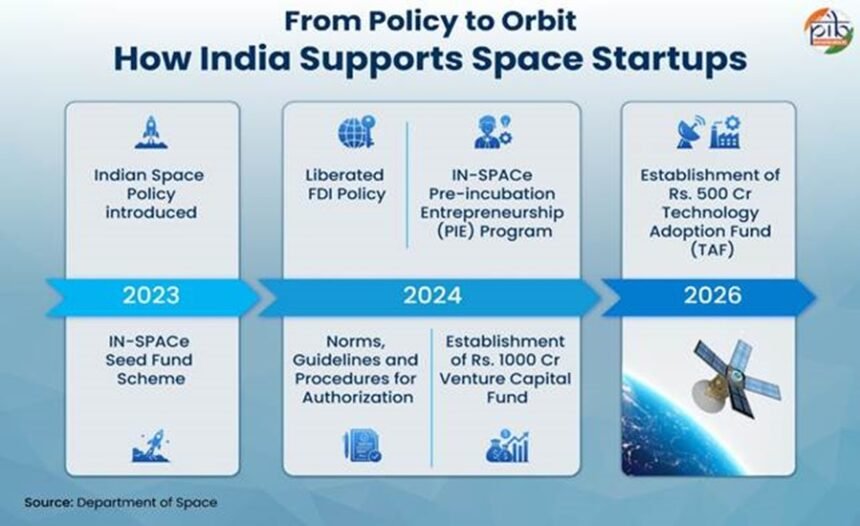
The 2023 policy let private companies into the space ecosystem and pushed for more innovation, international partnerships, and commercial activity. A big part of making that work is IN-SPACe, the Indian National Space Promotion and Authorisation Centre, which acts as a single-window regulator for private space activities. As of June 2026, it had registered more than 4,500 organizations, issued 133 authorizations, and signed 106 MoUs.
IN-SPACe has also brought in real money. In 2025 alone, it helped funnel around $150 million into Indian space startups. By June 2026, it had backed 118 technology transfer agreements and 189 partnership agreements.
Funding for startups
A few programs are feeding the startup pipeline:
- The IN-SPACe Seed Fund Scheme, which gives early-stage startups and MSMEs grants of up to ₹1 crore
- A ₹1,000 crore Venture Capital Fund running from FY 2025–26 through FY 2029–30
- A ₹500 crore Technology Adoption Fund, covering up to 60% of project costs for startups and MSMEs (40% for larger companies), capped at ₹25 crore per project
NSIL’s expanding role
The 2023 policy also gave more weight to NewSpace India Limited (NSIL), ISRO’s commercial arm, which builds and sells space systems and helps commercialize ISRO’s technology. Its revenue has grown roughly tenfold in recent years, and by July 2026 it had launched 141 satellites total, 138 of them for international or commercial customers and three for India.
Looser FDI rules
To pull in more foreign investment, the government eased FDI limits:
- Satellite manufacturing and operations: up to 74% automatic
- Launch vehicles and spaceports: up to 49% automatic
- Satellite components and subsystems: up to 100% automatic
A few milestones stand out. NSIL ran India’s first dedicated commercial LVM3 mission in October 2022, putting 36 OneWeb satellites into orbit. Vikram-S, India’s first private rocket, flew its demo mission that same November under Mission Prarambh. Agnikul Cosmos launched from India’s first private pad at Sriharikota in May 2024, using what it says is the world’s first single-piece 3D-printed semi-cryogenic engine.
Key Takeaway: IN-SPACe also approved a partnership led by Pixxel (with Dhruva Space, SatSure Analytics India, and Piersight Space) to build an Earth observation satellite constellation, and in February 2026 it arranged the ₹511 crore, 10-year transfer of SSLV technology to Hindustan Aeronautics Limited. Separately, Bellatrix Aerospace tested an indigenous green propulsion system under DRDO funding. As Vikram-1 gets ready to fly, it’s a test of both the rocket itself and the policy changes that made a private Indian launch vehicle possible in the first place.
MCQs:
1. Which private company developed India’s first privately built orbital launch vehicle, Vikram-1?
A. Agnikul Cosmos
B. Bellatrix Aerospace
C. Skyroot Aerospace
D. Pixxel
2. Which policy opened India’s entire space value chain to private participation?
A. National Space Policy 2017
B. Indian Space Policy 2023
C. Space Activities Bill 2024
D. Make in India Policy 2020
Read more: A Win for Shoppers: New Edible Oil Packaging SOP Makes Price Comparison Effortless