
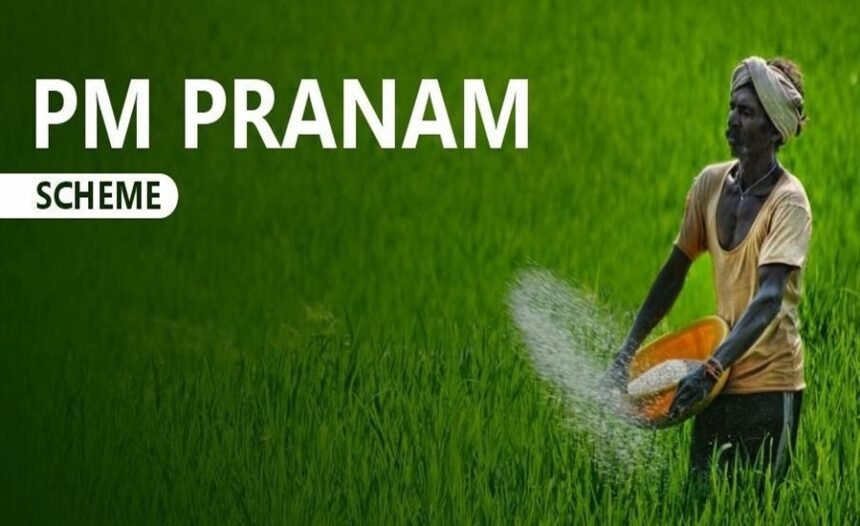
The government has a mix of programmes underway to shift Indian agriculture towars sustainable alternatives. The centerpiece is PM-PRANAM (PM Programme for Restoration, Awareness Generation, Nourishment and Amelioration of Mother Earth), which works alongside organic farming schemes, natural farming initiatives and precision nutrient management efforts. The broader aim is better soil health and less reliance on chemical inputs over time.
The Cabinet Committee on Economic Affairs approved PM-PRANAM on 28 June 2023, covering the period from 2023–24 through 2025–26. It works by rewarding States and Union Territories that cut back on chemical fertilizer use.
How PM-PRANAM works
The scheme applies across all States and Union Territories, offering incentives for reducing consumption of Urea, DAP, NPK and MOP relative to each region’s average use over the previous three years. States get back 50% of whatever fertilizer subsidy is saved this way, with 95% of that going to the State or Union Territory itself and the remaining 5% held by the Centre.
States have to spend their share in specific ways: 65% goes toward capital expenditure projects, ideally under existing Centrally Sponsored Schemes, while the other 30% can cover other activities, including awareness and communication efforts.
So far, five States and Union Territories, Dadra and Nagar Haveli, Delhi, Goa, Manipur and Mizoram, cut chemical fertilizer use by a combined 0.18 lakh metric tonnes during 2025–26 compared to their three-year average. That said, the government has confirmed that no incentive payments have gone out yet.
Organic and natural farming keep growing
Alongside PM-PRANAM, two older schemes continue supporting organic farming: the Paramparagat Krishi Vikas Yojana (PKVY) and the Mission Organic Value Chain Development for North Eastern Region (MOVCDNER), both dating back to 2015–16.
PKVY gives farmers ₹31,500 per hectare spread over three years, with ₹15,000 of that transferred directly for organic inputs. Since it started, the scheme has reached 18.93 lakh hectares and 33.63 lakh farmers, with ₹2,811.36 crore released as of 30 June 2026.
MOVCDNER works similarly but with higher amounts, ₹46,500 per hectare over three years, ₹32,500 of which supports organic inputs (₹15,000 via direct transfer). It’s covered 2.36 lakh hectares and 2.74 lakh farmers, with ₹1,548.62 crore released so far.
A newer addition, the National Mission on Natural Farming (NMNF), launched on 25 November 2024. It promotes farming without chemicals, tying together livestock integration, crop diversity and traditional techniques. The mission runs on a ₹2,481 crore outlay, split between a ₹1,584 crore Central share and ₹897 crore from the States. Farmers who adopt natural farming can get ₹4,000 per acre annually for two years, capped at one acre each.
In FY 2025–26 alone, the mission set up 18,893 clusters spanning 10.32 lakh hectares and reaching 20.93 lakh farmers. It also trained 33,257 Krishi Sakhis and Community Resource Persons, established 7,601 Bio-Input Resource Centres, ran awareness drives for 33.89 lakh farmers, and collected 18.13 lakh soil samples. Out of ₹725 crore allocated for the year, ₹599.68 crore was actually spent. More than 22.47 lakh farmers have registered for certification under the Natural Farming Certification System, and 14.43 lakh have already received it.
Key Takeaway: On the technical side, ICAR has built drip fertigation schedules covering 50 crops across 14 agro-ecological regions, now being shared through Krishi Vigyan Kendras, field demonstrations and farmer training sessions. ICAR has also standardized the use of organic alternatives like Farm Yard Manure, phosphocompost, vermicompost, bio-enriched compost and municipal solid waste compost, promoting them through the same kind of hands-on outreach.
MCQ’s:
1. PM-PRANAM aims to encourage States and Union Territories to:
(A) Increase fertilizer subsidies
(B) Reduce the consumption of chemical fertilizers
(C) Promote exports of fertilizers
(D) Expand fertilizer manufacturing capacity
2. Which of the following schemes was launched on 25 November 2024 to promote chemical-free farming in India?
(A) Paramparagat Krishi Vikas Yojana (PKVY)
(B) PM-PRANAM
(C) National Mission on Natural Farming (NMNF)
(D) Mission Organic Value Chain Development for North Eastern Region (MOVCDNER)