
Nearly 85 out of every 100 barrels of crude oil India uses come from somewhere else. That single number explains why the country flinches every time something goes wrong overseas. Successive governments have tried to change this equation by backing compressed biogas as a homegrown alternative, but years into the effort, the results on the ground are thin. What the sector actually needs now is money and incentives, not more targets.
A war far away, felt at home
When the Israel-U.S.-Iran conflict disrupted oil flows, India felt it immediately, because so much of its crude comes from West Asia in the first place. New Delhi has since spread its buying across more countries, which helps. But LPG is a different story: roughly nine out of every ten litres imported still have to pass through the Strait of Hormuz. That’s a chokepoint India doesn’t control, and it means unrest anywhere near it becomes India’s problem too.
This is the backdrop against which biogas keeps getting pitched as a solution. The pitch is threefold: less dependence on imported fuel, a use for agricultural waste that would otherwise go to landfill, and extra income for rural households. It’s a good pitch. It just hasn’t delivered much yet.
Biogas, explained simply
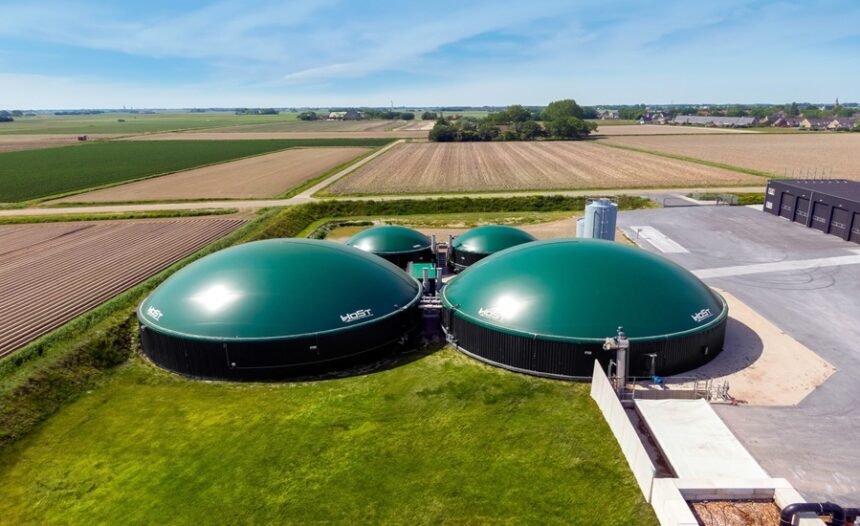
Strip away the jargon and biogas is just what you get when organic waste rots without oxygen: mostly methane and CO2, with traces of other gases. Clean it up and compress it, and you have CBG, which behaves exactly like CNG in an engine or a stove. It’s renewable, it doesn’t add new carbon to the atmosphere, and unlike oil, India can make as much of it as it has waste to feed it.
The country has been trying to work biogas into its gas supply for over ten years now. The SATAT scheme, launched in 2018, aimed for 5,000 plants within five years. Fast forward to June 2026, and only 132 exist. That gap between ambition and reality is the story of Indian biogas policy in one statistic.
There’s also GOBARdhan, a scheme built around turning organic waste into revenue. Districts can claim grants of up to ₹50 lakh to set up community biogas plants, and the government has set aside separate pots of money too: ₹564 crore for machinery to collect biomass, and ₹994 crore to lay pipelines linking biogas plants to the wider gas grid.
So why has so little of this materialised?
The money exists on paper, but four things keep getting in the way: patchy infrastructure, private investors staying on the sidelines, biogas developers struggling to get bank loans, and the sheer cost of the technology upfront. None of this is unsolvable. Cheaper financing, accelerated depreciation, and tax holidays would go a long way toward making these plants worth building for private companies.
Looking at where biogas has actually taken off worldwide, and it’s a short list: Europe, China and the U.S. together produce 90% of the global total. Within Europe, Germany leads, with France, Denmark and the U.K. not far behind. Germany’s turning point was the year 2000, when a new renewable energy law started paying producers guaranteed income and bonuses, and encouraged small operators to get into the business.
It worked, arguably too well. Farmers realised maize was suddenly a very profitable crop to grow for biogas feedstock, so they planted more and more of it, at the expense of other crops. Germans started calling it “corn mania.” It took the government more than ten years to notice the pattern was a problem and cap how much maize any single plant could use.
The same pattern, showing up in India
India’s own Economic Survey for 2026 raises a similar red flag: maize acreage has been climbing steadily, and that could squeeze out crop diversity and, eventually, food security. The numbers back this up. National maize yields rose from about 2.56 tonnes per hectare in FY16 to close to 3.78 tonnes per hectare in FY25. Over the same period, yields of soybean, sunflower, rapeseed, peanuts and millets barely moved, or fell.
Better farming technology could explain part of that jump. But there’s a simpler, money-driven explanation sitting right there: how the government prices ethanol.
Follow the ethanol price, find the incentive
India sets fixed per-litre prices for ethanol depending on what it’s made from, maize commands the highest price, rice the lowest, and molasses sits in the middle. That pricing structure hasn’t stayed still. Between FY22 and FY25, the price for maize-based ethanol climbed at nearly 12% a year, compounding. Every rupee added there is a rupee that makes maize a more obvious choice for a farmer deciding what to plant.
You can see the consequence in the data: maize acreage and output both grew sharply over that period, while pulses production actually fell, and oilseeds and other cereals inched up at best. States like Maharashtra and Karnataka show this most clearly, where maize is now elbowing out pulses, oilseeds, soyabean, millets and cotton for the same land, water and labour.
Why this should worry food policy, not just energy policy
Here’s the irony: India already buys large amounts of pulses and edible oils from abroad because it can’t grow enough domestically. A policy meant to reduce one kind of import dependence, on fuel, could end up deepening a different one, on food, if farmers keep drifting toward maize because that’s where the money is. And that leaves Indian food prices more exposed the next time global supply gets disrupted.
Denmark shows there’s another way to do this. It wants its entire gas network running on biomethane by 2030, and it has deliberately steered away from crop-based feedstock. Manure and farm waste do the job instead, no cropland trade-off required.
The government’s plan to force the issue
In 2023, regulators approved a mandatory blending rule: gas distributors now have to mix CBG into their supply starting in FY26, at 1% initially, climbing to 5% by FY29. Finance Minister Nirmala Sitharaman confirmed this direction in her February 2024 Budget speech, saying the phased blending of CBG into both CNG for transport and piped gas for homes “will be mandated.”
Building out the plants to actually meet that mandate is the harder part. Progress so far has been modest: in August 2025, Minister of State Shripad Yesso Naik told the Lok Sabha, “A total 36 number of medium size biogas plants have been installed under the Biogas Programme of MNRE during the last three years.”
Can biogas do what ethanol did?
There’s one precedent that gives the government reason for optimism. Ethanol blending in petrol was stuck at 1.5% in 2014. By December 2025, it had reached 20%, five years ahead of schedule. If CBG can follow anything like that trajectory, India’s energy security calculus could look very different by the early 2030s. Whether it will is still an open question.
Key Takeaway: Compressed biogas (CBG) has the potential to strengthen India’s energy security by reducing dependence on imported fossil fuels, promoting the productive use of agricultural and organic waste, and creating new income opportunities in rural areas. However, achieving these objectives will require faster expansion of biogas infrastructure, greater private investment, easier access to finance and supportive policy incentives to bridge the gap between ambitious targets and actual implementation.
At the same time, the experience of countries such as Germany and emerging trends in India underline the need to prioritise waste-based feedstock over dedicated energy crops to avoid adverse impacts on food security and crop diversity. As mandatory CBG blending is rolled out, balancing energy transition goals with agricultural sustainability will be crucial to building a resilient and self-reliant clean energy ecosystem.
M.C.Q.
Question 1: The SATAT Scheme, frequently seen in the news, was launched to:
- A. Promote solar-powered irrigation pumps
- B. Establish compressed biogas (CBG) plants and promote CBG as an alternative transport fuel
- C. Increase ethanol production from sugarcane only
- D. Develop offshore wind energy projects
Question 2: Under the Government of India’s Compressed Biogas (CBG) Blending Obligation, the mandatory blending target is proposed to increase from:
- A. 1% in FY26 to 5% by FY29
- B. 2% in FY25 to 10% by FY30
- C. 5% in FY26 to 20% by FY30
- D. 10% in FY26 to 20% by FY29
Read More: Ladakh’s New Autonomous Hill Councils: A Remarkable Shift