
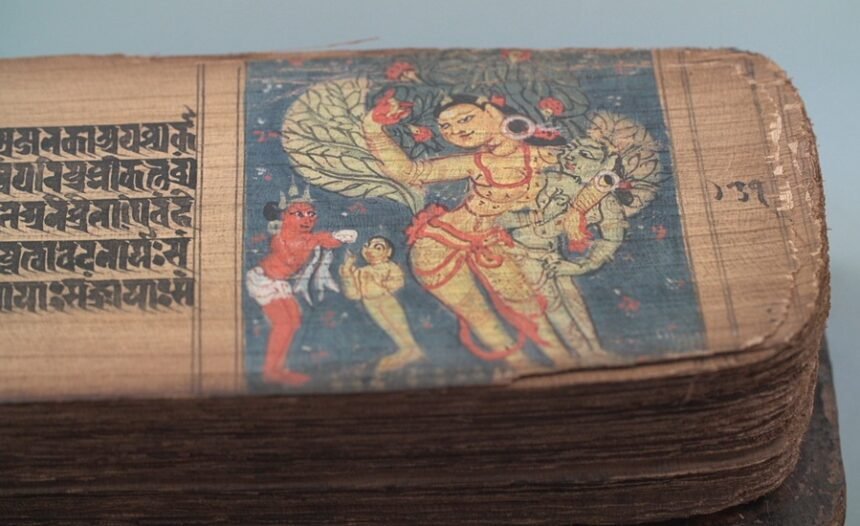
The Gyan Bharatam Mission (GBM), first announced in the Union Budget 2025-26, is a Ministry of Culture initiative focused on activities tied to India’s manuscripts. Its goals span several fronts: using advanced technology to speed up manuscript digitization and documentation, carrying out surveys and registration of manuscripts, and documenting and cataloguing Indian manuscripts wherever they happen to be, while keeping accurate, current records on them and the conditions in which they’re conserved.
The mission also wants to make manuscripts easier to access and use, whether through published books or machine-readable formats, and to support their conservation and preservation through training, awareness efforts, and financial backing. Beyond that, it aims to encourage scholarship and research into Indian languages and manuscriptology, and to build a National Digital Repository (NDR) that houses all of this centrally.
Funding and the National Manuscript Survey
To back this work, the Standing Finance Committee has sanctioned Rs. 491.66 crore for the period 2025 to 2031. A National Manuscript Survey launched in March 2026, covering every State and Union Territory in the country, with the goal of identifying and documenting manuscript holdings, the repositories that house them, and the custodians responsible for them, across a wide range of languages and scripts.
The survey has already turned up more than 1.19 crore manuscripts. Of these, over 8 lakh have been digitized nationwide, and more than 4.40 lakh of those are currently accessible to the public on the Gyan Bharatam portal, viewable state-wise in view-only mode.
How the Mission Is Organised on the Ground
GBM operates through an institutional structure built around Cluster Centres and Independent Centres, bringing together universities, research institutions, libraries, archives, private custodians, religious institutions, and other stakeholders to carry out manuscript-related work. States and Union Territories have also been brought in as Nodal Coordinating Authorities, each responsible for implementing Gyan Bharatam within its own jurisdiction.
Balancing Access With Custodial Rights
Access to digitized manuscripts is managed carefully, respecting the rights of the custodians and rights holders involved. Where it’s permissible, manuscripts and their associated metadata are made available to the public and to scholars through the National Digital Repository. But sensitive, restricted, or rights-protected material may come with additional access conditions to protect those rights.
A Pan-India Effort, With Institutions in Bihar Already Onboard
GBM is designed as a nationwide initiative, meant to preserve India’s manuscript heritage regardless of script, language, knowledge tradition, region, or the particular custodial traditions of any given community. In Bihar specifically, three institutions have already come on board to carry out manuscript-related work: Nava Nalanda Mahavihar in Nalanda, Khuda Bakhsh Oriental Public Library in Patna, and Bodh Gaya Math in Bodh Gaya.
Key Takeaway: The Gyan Bharatam Mission marks a major national effort to preserve and digitally safeguard India’s manuscript heritage by combining large-scale surveys, digitization, conservation, and research under a single institutional framework. Backed by ₹491.66 crore for 2025–2031, the mission has already identified over 1.19 crore manuscripts, digitized more than 8 lakh, and made over 4.40 lakh publicly accessible through the National Digital Repository while balancing scholarly access with custodial rights.
By bringing together governments, academic institutions, libraries, archives, and private custodians across all States and Union Territories, including key centres in Bihar, the initiative strengthens India’s cultural preservation ecosystem and promotes research in Indian languages and manuscriptology, making it an important development in the country’s cultural governance and heritage conservation efforts.
M.C.Q.
Question 1: The Gyan Bharatam Mission, announced in the Union Budget 2025–26, is primarily aimed at:
- A. Conserving India’s archaeological monuments through satellite mapping
- B. Preserving, digitising, documenting and promoting access to India’s manuscript heritage
- C. Digitising museum artefacts for international exhibitions only
- D. Promoting regional languages through school education reforms
Question 2: Which Ministry is responsible for implementing the Gyan Bharatam Mission?
- A. Ministry of Education
- B. Ministry of Electronics and Information Technology
- C. Ministry of Culture
- D. Ministry of Tourism
Read More: Vande Mataram Insult Now a Punishable Offence: Shocking Bill