
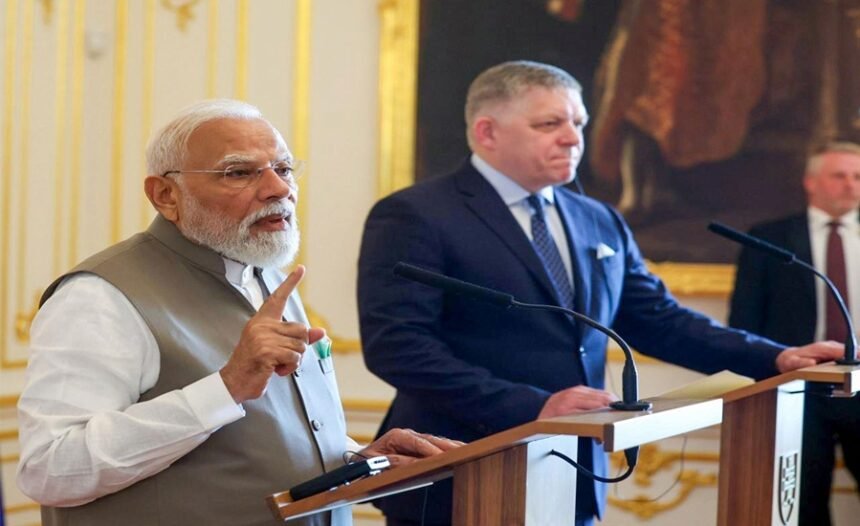
At the invitation of Prime Minister Robert Fico, Prime Minister Narendra Modi paid a State Visit to the Slovak Republic on June 15, 2026. It’s the first visit by an Indian Prime Minister to Slovakia since the country’s independence in 1993, marking a historic milestone in a relationship that’s been built on trust, equality and mutual respect since diplomatic ties began that same year.
Building on the historic weight of the visit, the two leaders agreed to elevate the relationship to a Comprehensive Partnership. The idea is to take bilateral ties to a new level, strengthen existing cooperation mechanisms and open up new avenues for working together, both bilaterally and on the world stage.
A Shared Vision for the Indo-Pacific and Global Institutions
Recognising how important the Indo-Pacific has become geopolitically, economically and technologically, both leaders acknowledged the value of a stronger India-Slovakia partnership in support of regional connectivity, open trade, freedom of navigation, peaceful dispute resolution and a rules-based international order. They agreed to keep up regular high-level exchanges and sustained political dialogue, and to increase delegation exchanges at every level, along with more parliamentary contacts and cooperation to share legislative experience and best practices.
Both leaders reaffirmed their commitment to multilateralism, with the UN at its centre, and called for comprehensive reform of institutions like the UN Security Council to make them more representative and reflective of today’s geopolitical realities. They specifically stressed the need to expand the Security Council in both its permanent and non-permanent categories. India welcomed Slovakia’s continued support for India’s bid for permanent Security Council membership, and the two agreed to keep coordinating on their respective candidacies in international organisations. They also discussed the global nonproliferation architecture, with Slovakia reaffirming its constructive stance on India’s membership of the Nuclear Suppliers Group.
Regional Groupings, Defence Ties and Disaster Resilience
The two sides agreed to support cooperation with regional groupings such as Slavkov 3, Visegrad 4 and the 3 Seas Initiative, including infrastructure projects that boost connectivity, sustainable growth and regional integration. They reaffirmed their commitment to a free, open, peaceful and prosperous Indo-Pacific grounded in international law, sovereignty, territorial integrity and the UN Convention on the Law of the Sea.
Defence and security cooperation was flagged as a key pillar of the partnership. The leaders agreed to encourage regular consultations between their defence authorities on defence technologies, capacity building, research and development, and industrial cooperation, and welcomed the signing of a Letter of Intent on Defence Cooperation. They also recognised the growing need for cooperation on disaster risk reduction and resilience, agreeing to work together on resilient infrastructure, capacity building, knowledge sharing and institutional cooperation.
Cybersecurity and a Firm Stand Against Terrorism
On the digital front, the leaders agreed to strengthen cooperation on protecting critical information infrastructure and countering cybercrime, while working toward an open, secure and resilient digital space. They also committed to helping each other prepare for quantum threats to cryptography, including the shift to post-quantum security, something a newly signed Memorandum of Cooperation on critical infrastructure protection and post-quantum cryptography is meant to support.
Both leaders condemned terrorism in all its forms, including cross-border terrorism, and specifically condemned the terrorist attack in Pahalgam, Jammu and Kashmir, on April 22, 2025. They agreed to set up a Joint Working Group on Counter-Terrorism and called for sustained international action against terrorism, including strong measures against entities designated by the UN Security Council’s 1267 Sanctions Committee and their affiliates, proxies, sponsors and financiers. They also underscored the need to hold perpetrators and sponsors of terrorist acts accountable, and agreed to keep pushing for the early adoption of the Comprehensive Convention on International Terrorism at the UN.
Trade, Investment and the India-EU FTA
The leaders welcomed the conclusion of negotiations on the India-EU Free Trade Agreement in January 2026, along with the new Joint India-EU Comprehensive Strategic Agenda, and called for the FTA to be signed and implemented soon to unlock trade and investment opportunities and diversify critical value chains.
They agreed to strengthen the India-Slovakia Joint Economic Committee’s role in identifying promising areas for economic cooperation, and committed to expanding bilateral trade and investment in automotive, electronics and other advanced manufacturing sectors, drawing on Slovakia’s industrial base and India’s scale and innovation ecosystem. On energy, the two sides agreed to work toward net-zero emissions through green energy technology exchange, and to diversify energy sources, including nuclear and geothermal power, through joint research and capacity building.
Water Management, Connectivity and Air Links
The leaders agreed to strengthen cooperation in meteorology and hydrology, sharing expertise on water resource management and dam safety, and to collaborate on rural drinking water quality, water treatment technology and climate-resilient rural water infrastructure.
Connectivity was flagged as a strategic pillar too. Both sides underscored the importance of joint ventures, technology transfer and skills development in the automotive and railway sectors, pointing to Slovakia’s role as a Central European transport hub alongside India’s manufacturing scale. They also agreed to explore direct air connectivity between the two countries to support growing economic and people-to-people exchanges.
Technology, Space and Healthcare Cooperation
The leaders welcomed the outcomes of the AI Impact Summit 2026 in Delhi, attended by Slovak President Peter Pellegrini, and the signing of a Memorandum of Understanding on Digital Technologies to structure cooperation in the digital domain. They agreed to deepen collaboration in AI, semiconductors, start-ups and research institutions, and to explore emerging areas like 5G use cases, 6G standardisation, IoT and machine-to-machine applications.
They also agreed to explore cooperation between their space ecosystems on satellite technology, encouraging exchanges between research institutions and industry. On healthcare, both sides committed to regular dialogue on pharmaceutical R&D, digital health solutions and building up health workforce capacity, along with sharing best practices in public health management.
Education, Culture and People Mobility
The leaders agreed to boost mobility for students, academics and researchers, particularly in STEM and humanities, and welcomed a Memorandum of Understanding between their education ministries to strengthen academic partnerships. They also committed to expanding cultural exchanges, tourism and people-to-people ties, including through artist exchanges, exhibitions and festivals, and welcomed a Memorandum of Understanding on Audio-visual Creation to support film and media collaboration.
Both sides expressed support for the safe and legal mobility of skilled professionals, noting the India-EU Comprehensive Framework of Cooperation on Mobility agreed in January 2026. They welcomed a Memorandum of Understanding on Labour Migration Cooperation and agreed to work toward a Social Security Agreement to protect the welfare of mobile professionals. They also agreed to set up a mechanism for regular consular consultations, given the growing movement of people between the two countries.
Looking Ahead
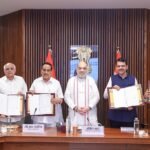
The leaders agreed to regularly review how the Comprehensive Partnership is being implemented, and both called the visit a significant step forward in transforming India-Slovakia relations, committing to carry the relationship into a new phase of engagement. They welcomed all the announcements and MoUs signed during the visit, which are available on the MEA website.
Prime Minister Modi thanked Prime Minister Fico and the people of Slovakia for their warm hospitality, and both leaders agreed to keep up the momentum of high-level exchanges.
Key Takeaway: The elevation of India–Slovakia relations to a Comprehensive Partnership marks a significant expansion of bilateral cooperation across strategic, economic and technological domains following the first-ever visit by an Indian Prime Minister to Slovakia since its independence in 1993.
The two countries reaffirmed their commitment to a rules-based international order, UN Security Council reforms, with Slovakia reiterating support for India’s permanent UNSC membership, and cooperation in defence, cybersecurity, counter-terrorism, digital technologies, artificial intelligence, semiconductors, space, energy, water management, healthcare, education and labour mobility. They also welcomed progress on the India–EU Free Trade Agreement, signed multiple MoUs across key sectors, and agreed to institutionalise regular high-level dialogue, laying the foundation for a long-term strategic partnership that strengthens India–Europe engagement and addresses shared regional and global priorities.
M.C.Q.
Question 1: During Prime Minister Narendra Modi’s 2026 visit, India and Slovakia agreed to elevate their bilateral relationship to the level of:
- A. Strategic Economic Partnership
- B. Comprehensive Partnership
- C. Comprehensive Economic Partnership Agreement (CEPA)
- D. Special Strategic and Global Partnership
Question 2: Which of the following international groupings or institutions did Slovakia reaffirm its support for with respect to India during the 2026 bilateral summit?
- A. India’s membership of NATO
- B. India’s permanent membership of the United Nations Security Council (UNSC)
- C. India’s accession to the OECD
- D. India’s membership of the Arctic Council
Read More: Narmada Award Dispute: Four States’ Unusual Water Settlement