
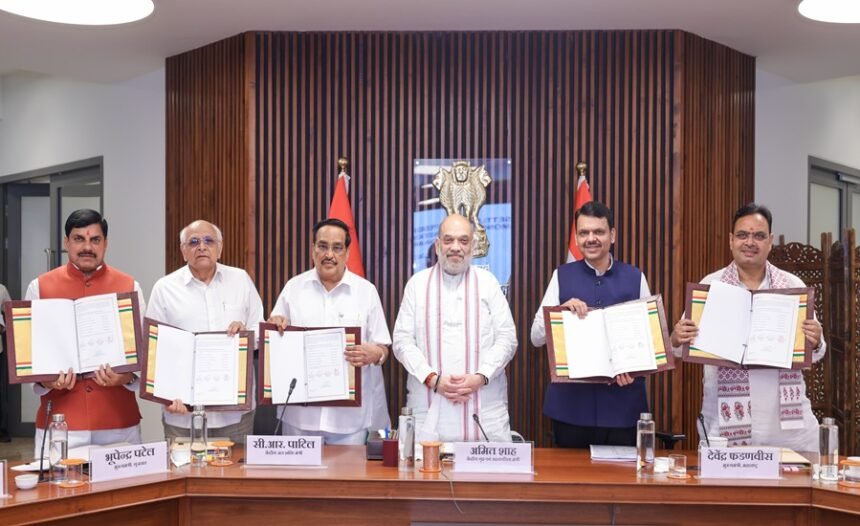
Maharashtra, Gujarat, Rajasthan and Madhya Pradesh reached an agreement on Tuesday, July 7, 2026, resolving pending payment issues among the Narmada Award beneficiary states. The agreement was signed in the presence of Home Minister Amit Shah and Union Minister of Jal Shakti C.R. Patil, with Chief Ministers Devendra Fadnavis (Maharashtra), Bhupendra Patel (Gujarat), Bhajan Lal Sharma (Rajasthan) and Mohan Yadav (Madhya Pradesh) putting their signatures on it. The pact deals with cost-sharing arrangements for the construction of the Sardar Sarovar Project.
A One-Time Settlement
Under the agreement, all payments toward the final settlement of pending dues have been resolved through a one-time settlement. Shah said the issue of pending payments under the Narmada Award had stayed unresolved between the four states for a long time, and that it was finally settled amicably on Tuesday.
He noted that with the dam now complete, water and electricity have reached every part of the four states. He added that while the benefits reaching Rajasthan might look modest on the surface, the areas that have received Narmada water have actually seen a real transformation, both in land values and in the fortunes of local farmers.
Water for the Country, Not Just One State
The Union Home Minister said that whether it’s Gujarat, Madhya Pradesh, Rajasthan, Haryana or Maharashtra, the water ultimately serves the people of the country, and especially its farmers. No matter which part of the country the water ends up being used in, he said, the one who benefits is an Indian.
About the Sardar Sarovar Project
The Sardar Sarovar Project is a terminal gravity dam built on the Narmada River near Navagam, Gujarat. Located near the Statue of Unity, it’s the largest major dam planned on the Narmada and ranks among the world’s largest concrete gravity dams by volume of concrete used. The idea of harnessing the Narmada River goes back to Sardar Vallabhbhai Patel in 1946, and the project picked up momentum when Prime Minister Jawaharlal Nehru laid its foundation stone in 1961.
The SSP is one of India’s largest water resource projects, spanning four major states: Maharashtra, Madhya Pradesh, Gujarat, and Rajasthan. It provides irrigation, drinking water, and hydropower that these regions depend on. The project has transformed arid, drought-prone areas, particularly in Rajasthan and Gujarat, lifting agricultural productivity and sending land values sharply upward.
Key Takeaway: The one-time settlement of long-pending financial dues among Maharashtra, Gujarat, Rajasthan and Madhya Pradesh marks the resolution of a decades-old issue related to the Narmada Water Disputes Tribunal (Narmada Award) and the cost-sharing arrangements for the Sardar Sarovar Project.
Built on the Narmada River in Gujarat, the project is one of India’s largest multipurpose river valley projects, providing irrigation, drinking water and hydropower to the four beneficiary states while transforming drought-prone regions through improved agricultural productivity and water security. The agreement highlights the importance of cooperative federalism in resolving inter-state water issues and ensuring the long-term benefits of major national infrastructure projects.
M.C.Q.
Question 1: The Sardar Sarovar Project, recently in the news, is built on which of the following rivers?
- A. Tapi
- B. Godavari
- C. Narmada
- D. Mahanadi
Question 2: Which of the following states is NOT a beneficiary state of the Sardar Sarovar Project under the Narmada Award?
- A. Gujarat
- B. Madhya Pradesh
- C. Rajasthan
- D. Chhattisgarh
Read More: AISHE Report 2023-24: India’s Outstanding Higher Education Growth