
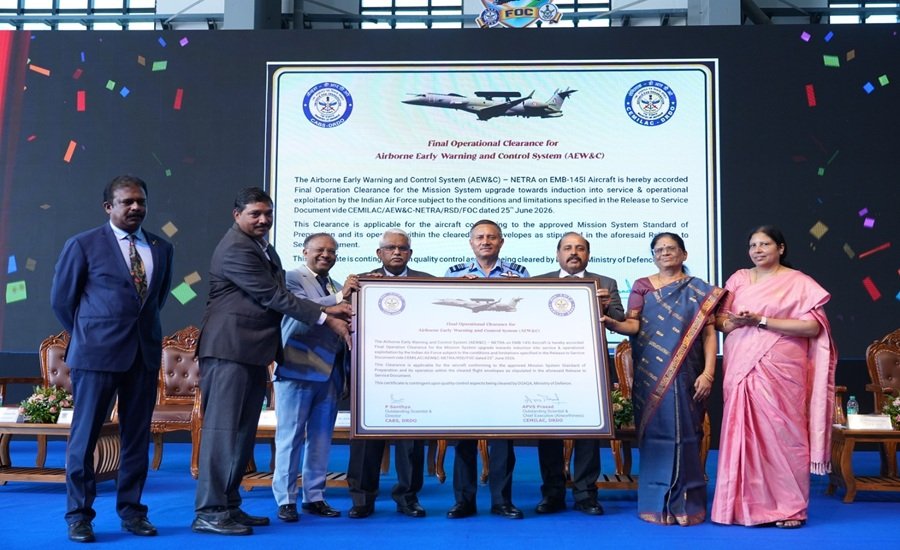
The Defence Research & Development Organisation (DRDO) has hit a major milestone, handing over the Final Operational Clearance (FOC) certificate for the indigenous ‘Netra’ Airborne Early Warning and Control (AEW&C) system to the Indian Air Force (IAF). The system was built indigenously through close collaboration between the IAF, DRDO, and partner industries, aimed at significantly boosting airborne surveillance, situational awareness, and battle management capability. It marks a landmark step in India’s push toward self-reliance in advanced aerospace and defence technology. The system received Initial Operational Clearance (IOC) back in 2017.
The Prestigious Ceremony
The ceremony was held in Bengaluru, Karnataka, on June 25, 2026, presided over by Deputy Chief of the Air Staff Air Marshal Awadhesh Kumar Bharti. Among those present were former Chief of the Air Staff Air Chief Marshal RKS Bhadauria (Retd), former DRDO Chairman Dr S Christopher, serving and retired senior IAF officers, Outstanding Scientist and Director of the Centre for Air Borne Systems (CABS) P Santhya, Outstanding Scientist and Chief Executive (Airworthiness) APVS Prasad, Scientist ‘G’ and Head of NETRA FOC AS Kumaran, other senior DRDO officials, and industry partners.
In his address, the Deputy Chief of the Air Staff praised the FOC achievement and spoke about how the system had already proved itself operationally, pointing to its use during Operation Sindoor and the Balakot strikes. He underlined why indigenous technology matters here, it gives the services the flexibility to modify and adapt the system as the nature of warfare evolves and credited the close coordination between DRDO, the IAF, and industry as the reason the programme succeeded.
Reflection To The Journey
Distinguished Scientist and Director General of DRDO’s Aeronautics Cluster, Dr K Rajalakshmi Menon, walked through Netra’s development journey, covering the challenges the team ran into and the decisions that ultimately got the system to a point where it could be handed over to the IAF as operationally capable. She pointed specifically to systems engineering as central to how flight tests were planned and carried out. Dr BK Das, Distinguished Scientist and Director General of DRDO’s Electronics Cluster, said the coordination among all stakeholders was the foundation the programme’s success was built on, calling Netra AEW&C a clear demonstration of self-reliance and a step toward ‘Viksit Bharat.’
The event also included special recognition for the organisations and units that played a key role in bringing the Netra AEW&C system from concept to operational reality. Organisers credited every stakeholder involved as essential to that transformation.
Key Takeaway: The induction of Netra AEW&C into operational service reflects DRDO’s broader push toward indigenisation, innovation, and strengthening the capabilities of the defence services. The programme is being held up as a model of how operational users, scientific institutions, and defence production bodies can work together. Raksha Mantri Rajnath Singh, commending DRDO, the IAF, and the industry partners, said the FOC achievement is both a technological milestone and a strategic step forward for India’s airborne surveillance and command-and-control capabilities. Defence Secretary and Secretary of the Department of Defence R&D, and DRDO Chairman, Rajesh Kumar Singh, congratulated DG (Aero) and the AEW&C team for reaching this milestone.
M.C.Q.
Question 1: The indigenous ‘Netra’ system, which recently received Final Operational Clearance (FOC), belongs to which category?
- A. Ballistic missile defence system
- B. Airborne Early Warning and Control (AEW&C) system
- C. Anti-tank guided missile
- D. Unmanned combat aerial vehicle
Question 2: The ‘Netra’ AEW&C system has been developed primarily by:
- A. Hindustan Aeronautics Limited (HAL)
- B. Bharat Electronics Limited (BEL)
- C. Defence Research and Development Organisation (DRDO)
- D. Indian Space Research Organisation (ISRO)
Read More: Cabinet Approves Additional 30,000 Crore for NIIF, Government Commitment Doubles to 60,000 Crore