
Kisan Sarathi launched in July 2021 with a fairly ambitious goal: get farmers, agricultural scientists, research bodies, and government schemes all talking to each other through one system. Today it’s India’s largest platform of its kind. MeitY and the Ministry of Agriculture built it jointly, with IASRI and the Digital India Corporation running implementation, and it delivers advice in multiple languages, adjusted for wherever a given farmer actually is.
The problem it was solving
Farmers used to bounce between separate systems, one for weather, another for scheme eligibility, a third for actual crop advice, assuming they could reach anyone at all. Kisan Sarathi consolidates that. Its backbone is the Interactive Information Dissemination System, IIDS, which breaks from the old one-way advisory model: instead of just broadcasting bulletins, farmers can ask something and get an answer back.
That advice is grounded in a fairly substantial institutional network, over 730 Krishi Vigyan Kendras, more than 100 ICAR research institutes, over 65 agricultural universities, so what farmers receive is meant to be scientifically sound while still fitting local growing conditions.
Linked systems
The platform also connects to other government digital services already in use: the Kisan Call Centre, Common Service Centres, the India Meteorological Department, MyScheme, and the BHASHINI language platform. That means weather data, scheme information, and language support all live in one ecosystem rather than several disconnected ones.
Access isn’t limited to smartphone users, either. Farmers can reach Kisan Sarathi through call centres, Common Service Centres, a web portal, a mobile app, or WhatsApp, covering people at very different levels of digital comfort and connectivity.
What’s actually delivered
Advisories cover cereals, pulses, oilseeds, horticulture, plantation crops, fodder, livestock, fisheries, and poultry, alongside real-time weather, mandi prices, scheme recommendations, PM-KISAN status updates, training sessions, video consultations, and expert guidance in local languages. As of 25 June 2026, farmers had access to information on 610 government schemes, 102 of them central.
Key features include profile-based personalization, live expert access in 13 regional languages, voice calling and conferencing, a knowledge database, location-triggered notifications, and registration simple enough to do over a toll-free call.
The IIDS system itself runs on voice, video, text, and image exchange, and farmers can adjust their subscriptions whenever their needs change. One useful detail: experts can pull up a farmer’s past interactions before answering a new question, so guidance builds on history instead of starting cold each time, an approach the platform calls Know Your Farmer.
Reach as of mid-2026
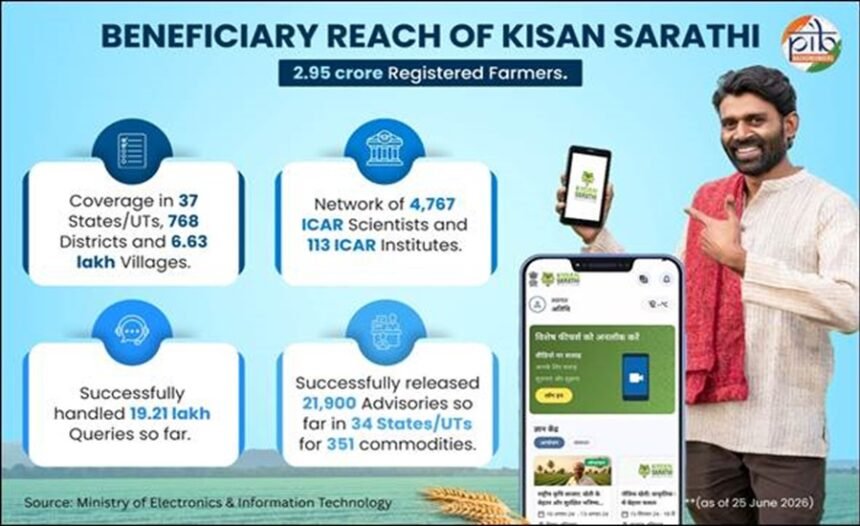
By 25 June 2026, Kisan Sarathi was live in 36 states and union territories, 768 districts, 6.63 lakh villages. Its expert base runs to 4,767 ICAR scientists across 113 institutions, and registered farmers total 2.95 crore, with 56.16 lakh of them women.
Most registrations, 2.89 crore, came through Krishi Vigyan Kendras. The remainder split across Kisan Call Centres (5.35 lakh), Common Service Centres (39,193), the mobile app (21,517), and the web portal (2,416). The platform has handled over 19.21 lakh farmer queries and put out 21,900 advisories spanning 351 agricultural commodities across 34 states and union territories.
Wider effects
Research institutions get a direct channel to see their work applied in the field. KVKs and extension experts can push advisories out faster and close farmer queries quicker than the old system allowed. And administrators get real-time dashboards and field data they can actually use for policy, rather than working off delayed survey numbers.
Key Takeaway: Roughly five years since launch, Kisan Sarathi has stitched together pieces of agricultural extension that used to operate separately, research, advisory, weather, schemes, into something farmers can access through whichever channel suits them. The registration numbers so far suggest real usage rather than just funding on paper, though further growth will depend on continued digital infrastructure expansion and farmer uptake in the districts it hasn’t fully reached yet.
MCQs:
1. Kisan Sarathi was launched in which year?
A) 2019
B) 2020
C) 2021
D) 2022
2. Kisan Sarathi was launched in which month?
A) January 2021
B) March 2021
C) July 2021
D) October 2021
Read more: Govt Launches SHE-LEAPS: A Digital Platform to Empower Rural Women Entrepreneurs