
Tourism has become one of the biggest engines of growth in India, it creates jobs, keeps local businesses running, and adds real weight to national income. Per the Ministry of Tourism’s India Tourism Data Compendium 2025, the sector’s total economic impact accounts for 5.22% of India’s GDP, with 2.72% coming from direct contribution alone. On the jobs side, it supports 13.34% of total employment, 5.82% of that direct.
Given how much tourism ripples out into hospitality, transport, handicrafts, and services, the Union Budget 2026-27 puts it front and center in India’s growth plans, with money going toward infrastructure, skills, heritage conservation, and destination development.
Spiritual and heritage tourism gets a push
The Budget introduced a new Scheme for Development of Buddhist Circuits in the North-East, aimed at building up infrastructure around major Buddhist sites in Arunachal Pradesh, Assam, Sikkim, Manipur, Mizoram, and Tripura.
That means preserving temples and monasteries, building pilgrimage interpretation centres, improving connectivity, and upgrading visitor amenities, the goal being to put the region on the global Buddhist map while supporting local livelihoods along the way.
This builds on the Swadesh Darshan Scheme, which started in 2014-15, and its follow-up, Swadesh Darshan 2.0, focused on responsible tourism, heritage conservation, community involvement, and sustainable livelihoods. So far, 76 projects worth ₹5,290.33 crore have been sanctioned under Swadesh Darshan, and 75 of them are already done.
Eco-tourism and connectivity
Proposals for eco-friendly mountain and nature trails in Himachal Pradesh, Uttarakhand, Jammu and Kashmir, Araku Valley in the Eastern Ghats, and Podhigai Malai in the Western Ghats have also been implemented.
There’s more beyond that: turtle trails along nesting sites in Odisha, Karnataka, and Kerala, and bird-watching trails around Andhra Pradesh’s Pulicat Lake. Better rail links, regional transport, and improved access to remote areas should help bring these newer destinations into the mainstream travel circuit while giving local economies a lift.
India will host the first Global Big Cat Summit
In 2026, India is set to host the world’s first Global Big Cat Summit, bringing together leaders and ministers from 95 big cat range countries to talk conservation, habitat protection, scientific cooperation, and sustainable wildlife tourism.
It’s a sign of India’s growing role in conservation diplomacy, and it ties into the country’s work setting up the International Big Cat Alliance (IBCA), a treaty-based intergovernmental organisation headquartered in India. Worth noting: India is home to five of the world’s seven big cat species: tiger, lion, leopard, snow leopard, and cheetah which makes it a fairly natural fit to lead on this front.
Building up skills and institutions
To deal with skill shortages in hospitality and tourism, the Budget proposes upgrading the National Council for Hotel Management and Catering Technology into a full National Institute of Hospitality, with industry-focused education, research, and international partnerships.
There’s also a pilot programme to train 10,000 guides across 20 major destinations, run in partnership with an Indian Institute of Management. It’s a 12-week hybrid course mixing classroom time, field training, and digital learning, meant to raise service quality and the overall visitor experience. This sits alongside existing programmes like Capacity Building for Service Providers (CBSP) and the Incredible India Tourist Facilitator (IITF) scheme.
Digital and heritage infrastructure
The Budget also announced a National Destination Digital Knowledge Grid, a platform to digitally document India’s cultural, spiritual, and heritage assets. It’s meant to help researchers, historians, content creators, and tourism planners while making destinations easier to find and manage.
On top of that, 15 archaeological sites including Lothal, Dholavira, Rakhigarhi, Adichanallur, Sarnath, Hastinapur, and Leh Palace will be turned into experiential cultural destinations, with curated walkways, interpretation centres, better visitor facilities, and heritage conservation work. This complements existing schemes like PRASHAD, SASCI, and Swadesh Darshan 2.0.
Medical tourism and wellness
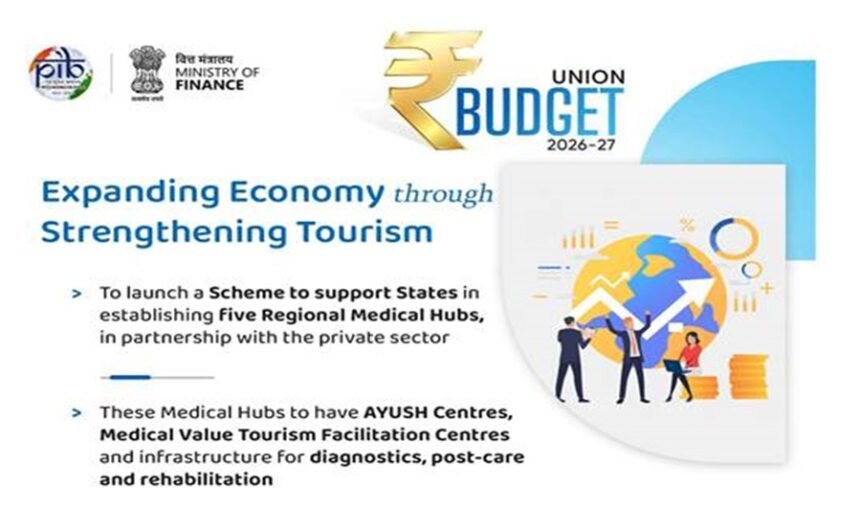
India is also working to build itself up as a destination for medical and wellness tourism. The Budget proposes financial support for states to set up five regional medical hubs, combining advanced healthcare, AYUSH centres, diagnostics, rehabilitation services, and medical tourism infrastructure through public-private partnerships.
This adds to India’s broader wellness tourism push, which includes work tied to the WHO Global Traditional Medicine Centre in Jamnagar.
Focus on the Purvodaya states
Under the government’s Purvodaya vision, the Budget announced five major destinations across Bihar, Jharkhand, West Bengal, Odisha, and Andhra Pradesh.
To help people actually get around these areas, 4,000 electric buses will be rolled out across the region. It ties in with infrastructure work under the East Coast Industrial Corridor, with the goal of unlocking eastern India’s tourism potential through better connectivity and more joined-up planning.
Key Takeaway: Between the Buddhist circuits, wildlife tourism, heritage conservation, medical and digital infrastructure, the Union Budget 2026-27 treats tourism as a serious lever for jobs, investment, and regional development.
Put the infrastructure spending together with the skills training, cultural preservation, and community involvement, and India looks to be building a real foundation for tourism-led growth while backing its case as a global destination for heritage, spirituality, nature, and wellness.
MCQs:
1. According to the India Tourism Data Compendium 2025, tourism’s total contribution to India’s GDP is approximately:
A) 3.15%
B) 4.48%
C) 5.22%
D) 6.74%
2. The direct contribution of tourism to India’s GDP is:
A) 1.95%
B) 2.72%
C) 3.84%
D) 5.82%
Read more: National Academic Depository (NAD) – Digital Governance in Education