
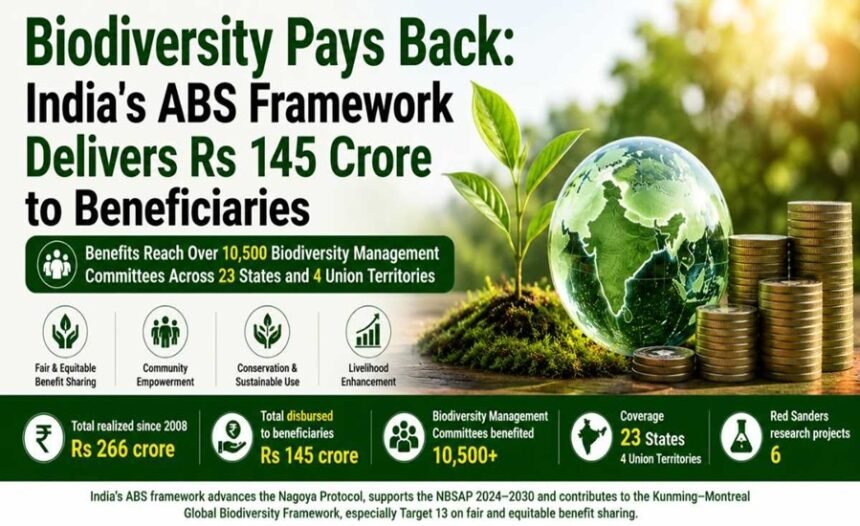
India’s Access and Benefit Sharing (ABS) framework, set up under the Biological Diversity Act, 2002, has generated more than ₹266 crore through benefit-sharing arrangements and passed on around ₹145 crore to local communities and other beneficiaries. The mechanism is meant to make sure the gains from using biological resources get shared fairly with the people and communities connected to them.
Moreover the National Biodiversity Authority also known as the (NBA), has mobilised over ₹266 crore since 2008, with ₹21.26 crore of that coming in during FY 2025-26 alone. While annual collections average around ₹14.75 crore, which accentuates the fact that more industry players are taking part and complying with biodiversity rules.
Under ABS, money earned from the commercial use of biological resources and traditional knowledge gets shared with Biodiversity Management Committees, farmers, traditional knowledge holders, local communities and other biodiversity custodians. Of the ₹266 crore collected so far, nearly ₹145 crore has already gone out, including about ₹78 crore in FY 2025-26 alone.
Reach across the country
These benefits have reached more than 10,500 Biodiversity Management Committees spread across 23 states and four Union Territories, along with over 230 farmers, six state forest departments and several other institutions. The framework has also funded six research projects tied to Red Sanders conservation and use.
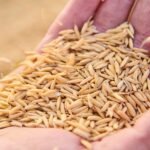
The ABS mechanism covers a broad set of biological resources: Red Sanders, medicinal and aromatic plants, livestock genetic resources, seeds, crude herbs, microorganisms and biochemical compounds. By tying commercial use of these resources to community welfare, the framework encourages conservation and sustainable use while creating livelihoods at the grassroots level.
Red Sanders leads collections
By sector, Red Sanders brought in the largest share of ABS collections at ₹120 crore, roughly 45% of the total. Seeds came next at ₹84.61 crore, or 32.3% of collections, and pharmaceuticals and AYUSH products contributed ₹36.61 crore, about 13.8%. Between them, these three sectors make up nearly 91% of everything mobilised under the framework.
A range of companies across agriculture, pharmaceuticals, biotechnology and consumer goods have paid into the ABS pool, including businesses working in seeds, herbal products, enzymes, cosmetics and other bio-based products.
Under the Biological Diversity Rules, 2024, the National Biodiversity Authority passes on 85-90% of the funds it collects to State Biodiversity Boards, which then distribute the money to eligible communities and stakeholders.
Where the money goes on the ground
At the local level, this funding supports biodiversity conservation, habitat restoration, and the updating of People’s Biodiversity Registers. It also goes toward documenting traditional knowledge, setting up medicinal plant parks and community gene banks, running capacity-building programmes, and backing sustainable livelihood projects in rural and tribal areas.
Key Takeaway: India’s ABS framework also feeds into international commitments, including the Nagoya Protocol and the Kunming-Montreal Global Biodiversity Framework, particularly its Target 13 on fair and equitable benefit sharing. It ties into several Sustainable Development Goals too, touching on poverty reduction, sustainable consumption, climate action and the conservation of terrestrial ecosystems.
With more than ₹266 crore mobilised and ₹145 crore already reaching beneficiaries, India’s biodiversity benefit-sharing model has become a meaningful way of turning conservation work into real economic and social gains for local communities, while keeping natural resource use on a sustainable footing.
MCQs:
1. The Access and Benefit Sharing (ABS) framework in India has been established under which legislation?
A. Environment (Protection) Act, 1986
B. Forest Conservation Act, 1980
C. Biological Diversity Act, 2002
D. Wildlife (Protection) Act, 1972
2. The Nagoya Protocol, often seen in the news along with India’s ABS framework, primarily deals with:
A. Climate change mitigation
B. Conservation of wetlands
C. Fair and equitable sharing of benefits arising from the utilization of genetic resources
D. Control of hazardous waste movement
Read more: Pulse and Oilseed Procurement – PSS Scheme Benefits