
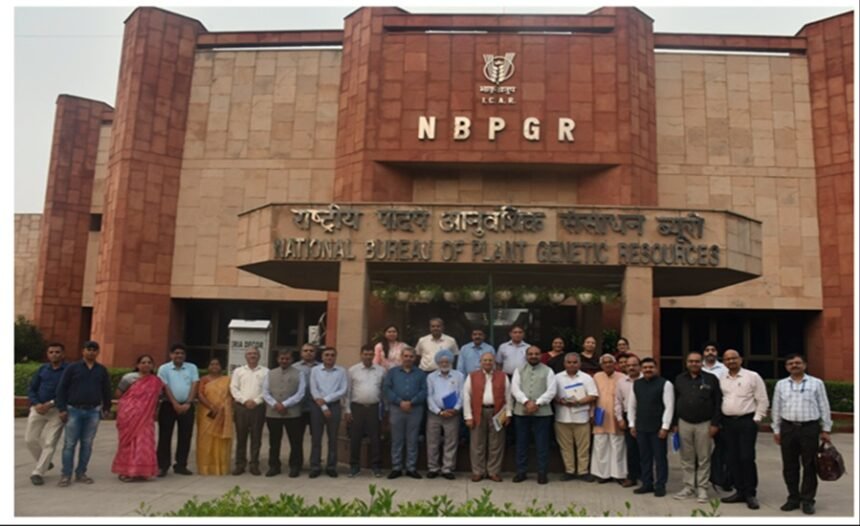
Genetic resources, spanning plants, animals, fish, microbes and insects, sit at the core of India’s food, nutrition, environmental and livelihood security. Recognising that, the newly reconstituted National Advisory Board on Management of Genetic Resources (NABMGR) held its first meeting on July 29, 2026, hosted at ICAR’s National Bureau of Plant Genetic Resources (ICAR-NBPGR) in New Delhi.
The Board itself isn’t new. ICAR’s President first set it up back in 2011 under Padma Bhushan Dr R.S. Paroda, who had earlier served as Secretary of the Department of Agricultural Research and Education (DARE) and as Director General of ICAR. This year, ICAR reconstituted it again, keeping Dr Paroda as chairman and adding Dr M.L. Jat, the current DARE Secretary and ICAR Director General, as co-chair.
The Board’s job is to bring together experts and stakeholders who can shape national policy on agrobiodiversity, push for coordinated management across all these genetic resource types, and weigh in on emerging issues both at home and internationally.
Who Showed Up
The July 29 meeting drew a wide cross-section of India’s biodiversity and agriculture establishment: senior representatives from the National Biodiversity Authority, the Department of Biotechnology, the Ministry of Environment, Forest and Climate Change, the Department of Agriculture and Farmers Welfare, the Department of Animal Husbandry and Dairying, the Botanical Survey of India, the National Medicinal Plants Board, and the National Seed Association of India. Bioversity International sent representatives too, alongside ICAR’s Deputy Directors General, the Directors of all six ICAR National Bureaux that manage genetic resources, farmer representatives, and other experts in the field.
Dr Paroda’s Opening Remarks
Dr Paroda opened by framing India’s genetic diversity across plants, animals, fish, microbes and insects as a national strategic asset, one that underpins long-term food security, nutrition, climate resilience and sustainable farming. He pushed each National Bureau to prioritise strategically, so that conservation work stays aligned with what the country actually needs going forward. He also flagged the value of putting conserved germplasm, wild relatives and species included, to greater use in crop, livestock and fish improvement programmes, arguing this would widen the genetic base and speed up development of climate-resilient, high-performing varieties and breeds.
He looked back to 2016 too, when India hosted the first International Agrobiodiversity Congress, inaugurated by Prime Minister Narendra Modi. He called for the recommendations from that Congress’s Delhi Declaration on Agrobiodiversity to actually get implemented, and asked for a review of progress made so far along with a clear roadmap going forward.
On the international front, he pushed for stronger collaboration with Central Asian and South-East Asian countries to ease access to valuable genetic resources, saying existing MOUs need reinforcing and germplasm exchange should be encouraged for crops like cotton, rambutan, avocado and mangosteen, plus livestock such as sheep from those regions. He also called for a legal framework protecting breeders’ and farmers’ rights over animal and fish genetic resources, modeled on the Protection of Plant Varieties and Farmers’ Rights Act, arguing it would spur innovation while still protecting livestock keepers and fish farmers.
Dr Jat on Integration and India’s Research System
Dr M.L. Jat made the case that managing genetic resources well can’t happen in isolation. It needs to connect with soil science, digital agriculture and crop improvement work. He pointed out that matching crop accessions to the right soil types and agro-ecological zones would speed up climate-resilient, location-specific production systems. He also credited India’s National Agricultural Research, Education and Extension System (NAREES), led by ICAR, for building strong capacity around conserving, characterising and sustainably using genetic resources, capacity that benefits both current and future generations.
With Ministries, Departments and ICAR Bureaux all represented on the reconstituted NABMGR, he said he expects better inter-agency coordination and stronger strategic guidance on conservation, sustainable use and equitable benefit-sharing from India’s genetic resources.
Bureaux Report Progress, Board Reviews Five Years of Work
Each of the six ICAR National Bureaux had their Directors present what they’d achieved between 2021 and 2026, along with roadmaps for the 2026 to 2031 period, built around national priorities and the Sustainable Development Goals.
Key Recommendations From the Board
The Board worked through several strategic questions on conserving and using agricultural genetic resources sustainably. It recommended beefing up pre-breeding programmes so conserved germplasm actually gets used more in crop improvement, identifying regions that haven’t yet been systematically surveyed for germplasm collection over 2026 to 2031, and getting the six Bureaux to collaborate more closely on a single integrated national framework for genetic resources management.
It also backed a full inter-institutional programme to mainstream traditional and opportunity varieties, breeds and species across plants, microbes, insects, animals and fish, an idea endorsed by Padma Shri Sunda Ram Verma, a progressive farmer who attended the meeting.
Beyond that, the Board reviewed how responsibilities for agrobiodiversity have been delegated from the National Biodiversity Authority to DARE and ICAR under the Biological Diversity Act, 2002, and discussed ways to strengthen Access and Benefit Sharing provisions. Members also looked at progress on the National Safety Genebank (NSG), with the Chairman pushing for it to be completed on schedule so it can be dedicated to the nation during ICAR’s centenary celebrations in 2028-29.
Looking Ahead
The meeting closed with the Board reaffirming its commitment to guiding policy on conserving and sustainably using India’s genetic resources, through stronger scientific collaboration, tighter institutional coordination and decisions grounded in evidence. The recommendations that came out of it are meant to strengthen how the country governs its agrobiodiversity and to support the broader Viksit Bharat vision by building agricultural resilience, food security and sustainable development.
Key Takeaway: The reconstituted National Advisory Board on Management of Genetic Resources has outlined a comprehensive roadmap to strengthen the conservation, sustainable use, and equitable management of India’s agrobiodiversity.
By promoting greater use of conserved germplasm in crop and livestock improvement, expanding germplasm collection, enhancing inter-agency coordination, strengthening Access and Benefit Sharing provisions under the Biological Diversity Act, 2002, and advancing initiatives such as the National Safety Genebank, the Board aims to improve climate resilience, food and nutritional security, and sustainable agriculture. These recommendations reinforce the strategic importance of genetic resources in supporting agricultural innovation, biodiversity conservation, and India’s long-term vision of resilient and sustainable development.
M.C.Q.
Question 1: The National Advisory Board on Management of Genetic Resources (NABMGR) primarily aims to:
- A. Regulate nuclear research in agriculture
- B. Provide strategic policy guidance on the conservation and sustainable use of India’s genetic resources
- C. Approve genetically modified crops for commercial cultivation
- D. Regulate imports of agricultural commodities
Question 2: Under which legislation were discussions on strengthening Access and Benefit Sharing (ABS) provisions reviewed during the NABMGR meeting?
- A. Environment (Protection) Act, 1986
- B. Protection of Plant Varieties and Farmers’ Rights Act, 2001
- C. Biological Diversity Act, 2002
- D. Seed Act, 1966
Read More: DAE’s Game-Changing Nuclear Push in Health and Farming