
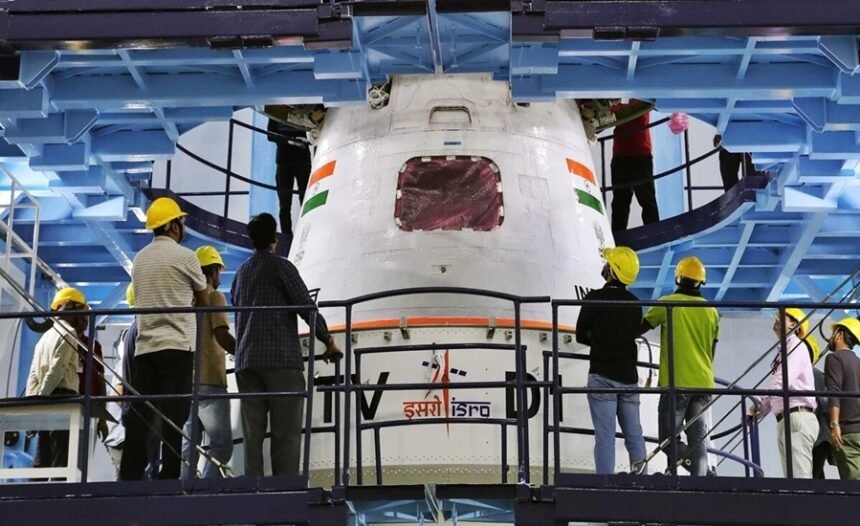
The Gaganyaan mission’s development work, all aimed at validating the systems needed for human spaceflight, has moved forward on several fronts. On the Human Rated Launch Vehicle (HLVM3), development and ground testing across every propulsion stage and structural component is now complete.
For the Orbital Module, the propulsion systems for both the Crew Module and Service Module have been built, tested and qualified. An engineering model for the Environmental Control & Life Support System (ECLSS) has also been realised. Beyond that, the deceleration system, the Crew Module Up-righting System, the Thermal Protection System and end-to-end avionics have all been developed and put through testing.
Crew safety systems and ground infrastructure
The Crew Escape System (CES) has seen five different types of motors developed and static tested, and every CES structure has been built and qualified. On the infrastructure side, several key facilities are now in place: the Orbital Module Preparation Facility, the Gaganyaan Control Centre, a dedicated Gaganyaan control facility, a crew training facility, and modifications to the second launch pad.
Test flights completed so far
Actual flight testing has already begun yielding results. The first Test Vehicle mission, TV-D1, meant to validate the Crew Escape System in flight, has been completed successfully. Two air drop tests, IADT-01 and IADT-02, both using a simulated Crew Module to check the deceleration system, have also gone off successfully. Work is now underway on the next milestone, the TV-D2 mission.
On the ground network and communications side, the overall configuration has been finalised, IDRSS-1 feeder stations and terrestrial links have been set up, and MoUs have been signed with other space agencies for cross-support arrangements. Recovery planning is also in place, with the necessary assets identified and a full recovery plan worked out.
Alongside all this, various ground qualification tests are continuing in parallel, aimed at proving out the new systems built specifically for Gaganyaan.
What’s coming next: uncrewed missions first
Before any astronaut flies, an uncrewed experimental mission is planned for the fourth quarter of 2026. This flight will validate several technologies being tried out for the first time, including the half-humanoid robot Vyommitra. After that, two more uncrewed missions, built to the exact configuration of the eventual crewed flight, along with the first crewed mission itself, are targeted for 2027.
Building the Bharatiya Antariksh Station
Looking further ahead, India’s own space station, the Bharatiya Antariksh Station (BAS), is targeted to become operational by 2035. ISRO has already worked out the station’s overall design, which will consist of five modules. The government has given the green light to develop and launch the first of these, BAS-01, and system engineering work along with technology development for its various subsystems is currently underway across ISRO’s centres and units.
To fund this entire effort, the Union Cabinet approved a budget of ₹20,193 crore in September 2024, covering a total of eight missions.
International partnerships powering the programme
ISRO isn’t doing this alone, it’s working with several international space agencies across different aspects of the programme. Network operations support for Gaganyaan missions is being provided through a collaboration with the European Space Agency (ESA). Separately, an Implementing Arrangement with the Australian Space Agency (ASA) is helping ISRO work out crew and Crew Module recovery procedures.
Cooperation with France’s CNES has enabled ISRO’s Flight Surgeons and Ground Support Teams to train at CNES and other European facilities. And ISRO signed an MoU with Russia’s State Space Corporation Roscosmos for joint work under the Human Spaceflight Programme, an arrangement that’s led to contracts for delivering subsystems like the Crew Seat, Viewport, Flight Suits and Wind Tunnel Testing, as well as general spaceflight training for the first batch of Gaganyatris at the Gagarin Cosmonaut Training Centre.
Key Takeaway: The Gaganyaan programme has now entered an advanced phase, with the Human Rated Launch Vehicle, Orbital Module, Crew Escape System, and critical ground infrastructure largely developed and validated through extensive testing, while successful test missions have paved the way for an uncrewed experimental flight in late 2026 and the first crewed mission in 2027.
At the same time, ISRO is laying the foundation for the Bharatiya Antariksh Station, targeted to become operational by 2035 with an approved outlay of ₹20,193 crore for eight missions, reflecting India’s long-term commitment to indigenous human spaceflight capabilities. Backed by collaborations with agencies such as ESA, the Australian Space Agency, CNES, and Roscosmos, the programme highlights India’s expanding technological expertise, international cooperation, and strategic ambitions in space exploration.
M.C.Q.
Question 1: What is the name of the half-humanoid robot that will fly on the uncrewed Gaganyaan mission to validate technologies for human spaceflight?
- A. Pragyan
- B. Vyommitra
- C. Vikram
- D. Garuda
Question 2: The Bharatiya Antariksh Station (BAS), India’s planned space station, is targeted to become operational by:
- A. 2028
- B. 2030
- C. 2035
- D. 2040
Read More: Clouded Leopard: India’s Remarkable New Conservation Plan