
Union Minister for Environment, Forest and Climate Change Bhupender Yadav addressed the Global Tiger Day 2026 celebrations organised by the National Tiger Conservation Authority (NTCA) in New Delhi. In his address, the Minister called for people to build a deeper connection with nature and adopt a more conservation-minded way of life. Union MoS (EFCC) Kirti Vardhan Singh was also present, along with senior government officials, wildlife experts, frontline forest personnel, students, and other stakeholders, all gathered to mark India’s progress in tiger conservation and renew their shared commitment to protecting tigers and their habitats.
Speaking on what conservation really means, Yadav said it goes well beyond simply protecting wildlife; it’s also about building a relationship of respect with nature. “Nature is not only a source of tourism or entertainment, it also needs to be respected and people must derive peace from it,” he said, encouraging people to draw inspiration from the natural world and commit themselves to a lifestyle centred on environmental conservation.
The Numbers Behind India’s Tiger Conservation Story
Turning to what India has achieved, the Minister pointed out that both tiger numbers (now at 3,682) and the count of tiger reserves (now at 58) have risen sharply under the leadership of Prime Minister Narendra Modi. He also noted that the last 12 years have seen growth in the number of elephant reserves, national parks, wildlife sanctuaries, protected areas, community reserves, and wetlands across the country.
Yadav also launched the NTCA Eco-tourism webpage, commending NTCA for bringing together information on every Tiger Reserve onto a single, integrated platform. The webpage links directly to the authentic websites of all Tiger Reserves, making it easier for visitors to book safaris and accommodation, while also encouraging tourism that’s responsible and sustainable. (Link: https://ntca.gov.in/eco-tourism/)
The Value of Documenting Conservation Experience
On the importance of putting conservation experience into writing, the Minister said, “The stories of forests is not bare data but it includes traditional knowledge, emotions, passion towards Wildlife Conservation and years long experiences of wildlife officers, Conservationists etc.” He urged forest officers to document their work on wildlife conservation more actively, framing their experiences in ways that could feed into practical, implementable policy solutions.
Strengthening Capacity and Global Knowledge-Sharing
Yadav also spoke about the need to build up the capabilities of forest officers and staff by drawing on global best practices. He pointed to the International Big Cat Alliance (IBCA) and its role, under Prime Minister Narendra Modi’s leadership, in extending India’s knowledge-sharing efforts on a global scale.
Honouring Those Working on the Ground
In recognition of on-ground conservation efforts, NTCA presented its awards to wildlife officers and other contributors for outstanding work in tiger conservation and protected area management. The celebration also served as an occasion to acknowledge frontline personnel, whose work remains central to wildlife conservation efforts.
Student Engagement and Awareness Campaigns
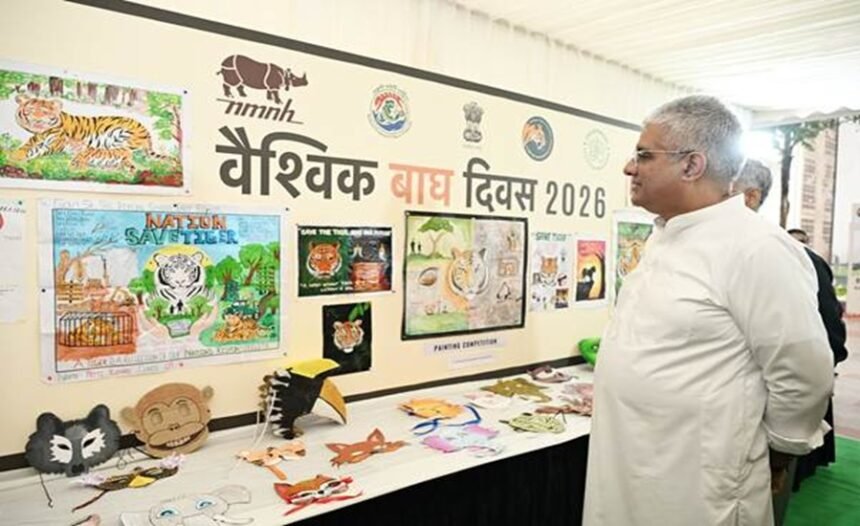
The Minister also toured an exhibition featuring the best entries from painting, sketching, slogan-writing, and mask-making competitions held on the theme “Save Tiger” for school children across Delhi-NCR. Alongside this, a nationwide awareness campaign on tiger conservation was carried out through Eco-clubs under the Ministry’s Environment Education Programme, with particular attention paid to schools located near Tiger Reserves.
Five New Publications Released
Five publications were unveiled during the celebrations, underscoring NTCA’s continued focus on science-based conservation, knowledge-sharing, and public awareness. These include the July 2026 edition of NTCA’s outreach journal STRIPES, a Security Audit Report covering 24 Tiger Reserves, a report assessing habitat suitability for Sloth Bears across India’s Tiger Landscapes, Tigers of the World (published by IBCA and GTF), and The Rehman Khera Tiger, authored by Chandra Prakash Goyal and Satya Prakash Yadav.
Altogether, Global Tiger Day 2026 reaffirmed India’s lasting commitment to tiger conservation, spanning recognition of excellence, scientific management, capacity building, responsible eco-tourism, knowledge-sharing, and wider public participation in protecting the country’s natural heritage.
Background: The Story Behind Global Tiger Day
A century ago, an estimated 1,00,000 wild tigers roamed across Asia. Today, they survive in less than 8% of their historic range, and three subspecies, the Bali, Javan, and Caspian tigers, have gone extinct altogether. This steep decline has been driven by poaching, illegal wildlife trade, habitat loss and fragmentation, human-wildlife conflict, and climate change.
In response to this urgent situation, leaders of the 13 Tiger Range Countries came together at the St. Petersburg Tiger Summit in 2010 to launch the Global Tiger Recovery Program (GTRP). That same Summit established Global Tiger Day, observed every year on July 29, and set the ambitious TX2 goal of doubling the world’s wild tiger population by 2022.
Since then, Global Tiger Day has functioned as a global platform for raising awareness about tiger conservation, deepening international cooperation, encouraging public involvement, and taking stock of progress made in protecting tigers and their habitats.
Key Takeaway: Global Tiger Day 2026 highlighted India’s sustained commitment to wildlife conservation through the expansion of tiger populations and protected areas, alongside initiatives promoting scientific management, habitat protection, responsible eco-tourism, capacity building, and public participation. With the launch of the NTCA Eco-tourism portal, recognition of frontline conservation efforts, publication of research-based reports, and continued engagement through platforms such as the International Big Cat Alliance (IBCA), India is strengthening both national and global efforts to conserve tigers.
These measures align with the broader objectives of biodiversity conservation, ecological sustainability, and international cooperation in safeguarding one of the world’s most iconic endangered species.
M.C.Q.
Question 1: With reference to Global Tiger Day, consider the following statements:
- It is observed every year on 29 July.
- It was established during the 2010 St. Petersburg Tiger Summit.
- It is associated with the TX2 Goal of doubling the world’s wild tiger population.
Which of the statements given above is/are correct?
- A. 1 only
- B. 1 and 2 only
- C. 2 and 3 only
- D. 1, 2 and 3
Question 2: The National Tiger Conservation Authority (NTCA) is primarily responsible for:
- A. Regulating timber exports from protected forests.
- B. Implementing and overseeing tiger conservation and the management of Tiger Reserves in India.
- C. Conducting wildlife censuses for all endangered species.
- D. Managing India’s biosphere reserves under UNESCO.
Read More: Ocean Network Expansion: India’s Powerful New Leap