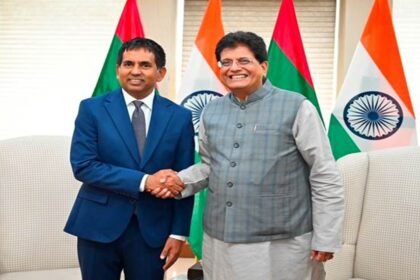

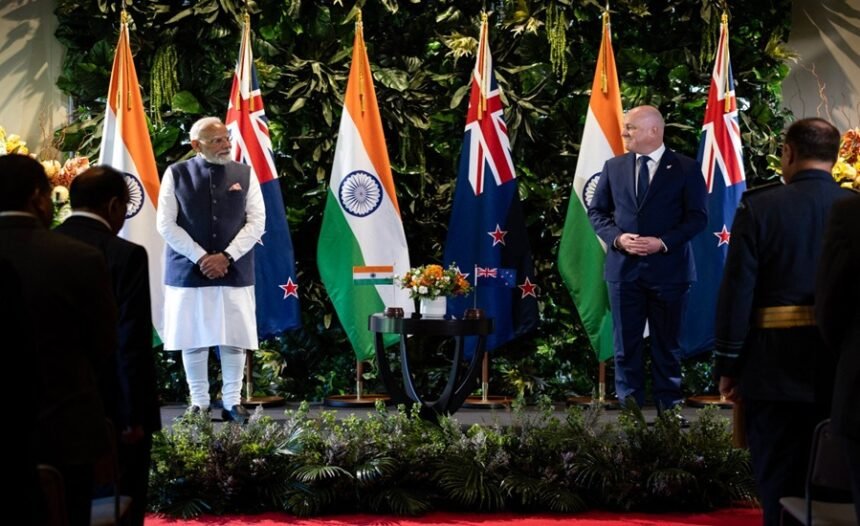
The Prime Ministers of India and New Zealand met in Auckland on 11 July 2026 and announced the launch of the India-New Zealand Strategic Partnership. They endorsed a Roadmap to 2030 as a shared framework to guide joint action and deepen the partnership over the next four years. The roadmap isn’t meant to be exhaustive; it covers a wide set of areas and initiatives organised under six pillars.
Pillar I: Political and Diplomatic Engagement
Both sides will aim to hold regular meetings and reciprocal visits between their Prime Ministers and Cabinet Ministers, including on the sidelines of regional and multilateral events, and will keep high-level cooperation running through a regular Foreign Ministers’ Dialogue. They also plan to intensify interactions between relevant Ministries and Government Departments across sectors of shared interest, and to promote more parliamentary exchanges and official visits between the two countries.
On top of that, they’ll consolidate the practice of annual meetings at the Secretary level in India’s Ministry of External Affairs and at Deputy Secretary (Americas and Asia) level in New Zealand’s Ministry of Foreign Affairs and Trade, giving both sides a mechanism to steer and coordinate how the Strategic Partnership and the Roadmap to 2030 actually get implemented.
Pillar II: Defence and Security Cooperation
Military interaction will continue through exercises, unit visits across maritime, air and land domains, short-term personnel exchanges, sporting visits, defence staff college exchanges, and high-level defence dialogues, along with more dialogue on defence matters, including at the Ministerial level. Both countries will keep implementing the 2025 India-New Zealand Memorandum of Understanding on Defence Cooperation and maintain structured engagement at the Defence Ministry and Service levels.
They’ll also put into practice the recently agreed Maritime Cooperation Arrangement, the Implementing Arrangement on Cooperation in Matters of Hydrography and Nautical Cartography, and a Mutual Logistics Support Arrangement focused on the maritime domain, which will include bilateral naval exercises. Maritime cooperation will extend further through the Maritime Security pillar of the Indo-Pacific Oceans Initiative, and both sides will set up an annual Maritime Security Dialogue led by India’s Ministry of External Affairs and New Zealand’s Ministry of Foreign Affairs and Trade.
On the counter-terrorism front, the two countries will operationalise the Memorandum of Arrangement establishing a Joint Working Group on Counter-Terrorism, led by the same two ministries, and hold its first meeting at a mutually agreed time. They’ll engage on shared cyber security priorities through the India-New Zealand Cyber Dialogue, and work toward formalising a Memorandum of Arrangement on combating trafficking of narcotic drugs, psychotropic substances, precursor chemicals and related matters.
Beyond that, they’ll work toward a Memorandum of Arrangement between India’s National Investigation Agency and the New Zealand Police on law enforcement cooperation, and strengthen collaboration through the Coalition for Disaster Resilient Infrastructure to make infrastructure systems more resilient.
Pillar III: Trade and Economic Cooperation
On bilateral trade, both countries are aiming to double two-way trade in goods and services to NZ$7 billion (₹35,000 crore) by 2030. They’ll also work together on the next steps for the India-New Zealand Free Trade Agreement, so it can enter into force early and be implemented effectively, and will operationalise the 2025 Authorised Economic Operators Mutual Recognition Arrangement under the 2024 Customs Cooperation Arrangement to simplify customs processes and support trusted trade.
In primary industries, the two sides will implement the 2025 Memorandum of Cooperation on Horticulture, covering joint research, knowledge exchange, post-harvest innovation and market development. They’ll also carry out the 2025 Letter of Intent on Forestry Cooperation through ongoing policy dialogue, technical exchanges and best-practice sharing, and implement the Memorandum of Cooperation on Animal Husbandry and Dairying for technical and policy collaboration.
On tourism, both countries will operationalise the Memorandum of Arrangement on Tourism to encourage two-way visitor flows and industry cooperation, and will push for tourism growth by encouraging airlines to start direct, non-stop flights under the updated Air Services Agreement.
Pillar IV: People, Culture, and Sport
Diaspora communities will be engaged as partners in strengthening people-to-people links between the two countries. Both sides will continue implementing the 2025 Memorandum of Cooperation on Sport and carry out the India-New Zealand Joint Action Plan on Sport, run jointly by India’s Ministry of Youth Affairs and Sports and Sport New Zealand. They’ll also support an expert-level exchange on traditional medicine.
On the maritime side, India’s Directorate General of Shipping (under the Ministry of Ports, Shipping and Waterways) and Maritime New Zealand will keep talking about ways to strengthen recognition of seafarer competency certificates, supporting both countries’ maritime industries. Cooperation will also continue under the Memorandum of Arrangement between the National Maritime Heritage Complex in Lothal, India, and the New Zealand Maritime Museum.
Rounding out this pillar, both sides will implement the Arrangement on Cultural Cooperation to build better mutual understanding, and will encourage cooperation between their local governments.
Pillar V: Education, Research, Science and Technology, and Disaster Management
The two countries will implement the 2025 Education Cooperation Arrangement between their respective Ministries of Education, keeping the exchange of information on each other’s education systems going, and will look to grow the number of government and institutional partnerships aligned with that arrangement’s goals.
On climate and energy, they’ll deepen cooperation on climate action and low-emissions transitions through the International Solar Alliance, with a focus on solar deployment, financing and capacity building, and will engage with the Global Biofuels Alliance to support sustainable energy transitions. Government officials, institutions and industry on both sides will also be encouraged to scope out and build bilateral partnerships in research, science, technology and innovation, particularly around agriculture, climate, digital transformation, and new and emerging technologies.
On disaster management, the two countries will implement a Memorandum of Cooperation between India’s National Disaster Management Authority and New Zealand’s National Emergency Management Agency, covering preparedness, emergency response and capacity building.
Pillar VI: Regional and Multilateral Cooperation
India and New Zealand will exchange views through ASEAN-led and other regional forums to support a rules-based Indo-Pacific, and will explore concrete cooperation under the Maritime Security pillar of the Indo-Pacific Oceans Initiative, backing the peaceful resolution of disputes in line with international law, particularly UNCLOS.
They’ll also strengthen cooperation at the United Nations and support UN reform, including India’s candidature for permanent membership of a reformed Security Council, and will exchange mutual support, where possible, for each other’s candidatures in multilateral and international organisations.
The Roadmap to 2030 comes with a clear caveat: it doesn’t create any financial commitments, and it doesn’t establish any legally binding rights or obligations under domestic or international law.
M.C.Q.
Question 1: The India–New Zealand Roadmap to 2030, launched in July 2026, is structured around how many pillars?
- A. Four
- B. Five
- C. Six
- D. Seven
Question 2: Under the India–New Zealand Roadmap to 2030, both countries have set a target to increase bilateral trade in goods and services to:
- A. NZ$5 billion by 2028
- B. NZ$7 billion by 2030
- C. NZ$10 billion by 2030
- D. NZ$12 billion by 2035
Read More: ESI Healthcare Projects: An Enormous ₹668 Crore Boost for Public Health Infrastructure