
India’s steel industry is having a moment since it became the world’s second-largest steel producer in 2018, it hasn’t just held that spot it’s kept building on it. Domestic production, consumption, and exports have all climbed steadily since then.
The numbers tell the story. India’s share of global crude steel production went from 5.2% in 2014 to 7.9% in 2024. Finished steel consumption more than doubled over roughly the same stretch, from 77 million tonnes (MT) in 2014-15 to 163.7 MT in 2025-26. Infrastructure spending, urbanisation, and manufacturing growth are the main forces behind that.
Production keeps climbing
Crude steel output rose from 88.98 MT in 2014-15 to 168.4 MT in 2025-26 marking a compound annual growth rate of about 9% between 2021-22 and 2025-26. Finished steel production reached 160.9 MT in 2025-26, with consumption right behind it at 163.7 MT.
The growth isn’t concentrated in one category. In April-September 2025-26 alone, hot metal production was up 7.3%, pig iron up 6.6%, and sponge iron up 9.1% year-on-year.
India has now hit around 66% of the National Steel Policy 2017 target of 255 MT by 2030-31 and is aiming higher still, with a longer-term goal of 500 MT by 2047.
Trade is shifting in India’s favor
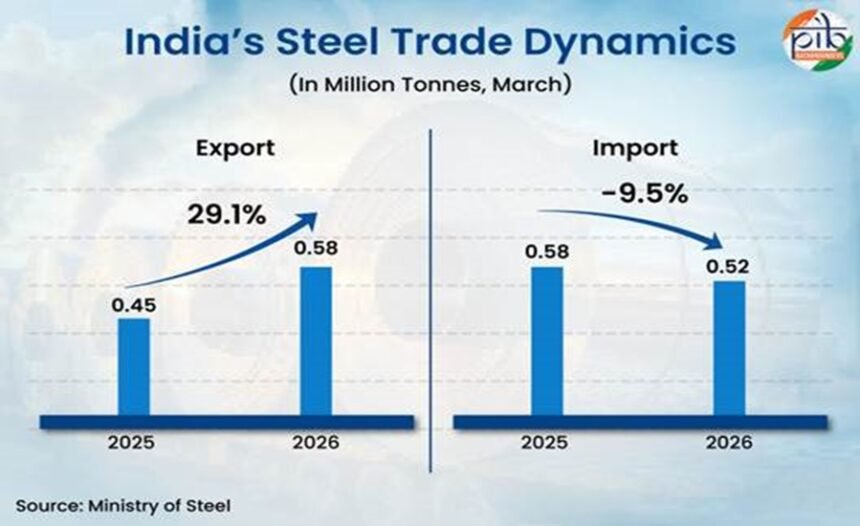
Exports rose 29.1% in March 2026 compared to March 2025, while imports dropped 9.5% over the same period. For the full 2025-26 fiscal year, finished steel exports were up 35.8% and imports fell 46.47%, a sign that domestic capacity is covering more of what used to come from abroad. Vietnam, Belgium, and Taiwan together took in more than half of India’s finished exports.
Government backing, especially for specialty steel
Specialty steel was folded into the Production Linked Incentive (PLI) scheme back in 2021, with a ₹6,322 crore outlay. Investment commitments under PLI 1.0 and 1.1 have since reached ₹44,106 crore, projected to add 14.34 million tonnes of production and 33,460 direct jobs.
As of 2026, the scheme has already produced:
- ₹23,022 crore in realised investments
- 2.4 million tonnes of specialty steel produced
- 13,264 direct jobs
- ₹236 crore in incentives paid out
- ₹6,000 crore in import substitution
A third phase, PLI 1.2, launched in November 2025. It covers 85 projects across 55 companies, ₹11,887 crore in investment, and roughly 8.29 MT of added capacity.
Building up domestic manufacturing
The revised Domestically Manufactured Iron and Steel Products (DMI&SP) policy and the “Melt and Pour” rule are both pushing toward more indigenous production and less reliance on imports. On the logistics side, the government has identified 12 major zones and folded more than 2,100 units into the PM GatiShakti platform for data-driven planning.
Raw material security got a boost too: customs duties on ferro nickel and molybdenum ores were cut to zero in the Union Budget 2024-25, and the Steel Scrap Recycling Policy is meant to shore up domestic scrap supply. Quality standards have tightened as well, with 143 Quality Control Orders now covering 723 products as of December 2025.
Reaching further abroad
The sector allows 100% Foreign Direct Investment under the automatic route. Between April 2000 and June 2025, metallurgical industries pulled in ₹1.6 lakh crore (about USD 18.67 billion) in investment. New trade agreements with the UK and the EU should open up further export opportunities.
Green steel is picking up speed
India wants net-zero emissions by 2070, and in 2024 it became the first country to introduce an official Green Steel Taxonomy. Under that taxonomy, steel counts as “green” if its emission intensity is below 2.2 tonnes of CO2 equivalent per tonne of finished steel. By March 2026, 89 units had earned green steel certification, covering 12.34 MT of production.
The decarbonisation plan works in stages: energy efficiency and renewables in the near term, green hydrogen and carbon capture in the medium term, and less-proven low-carbon technologies further out. Backing that up: a ₹20,000 crore allocation for Carbon Capture, Utilisation and Storage over five years (Union Budget 2026-27), four pilot projects under the National Green Hydrogen Mission, expanded scrap recycling, and 14 task forces set up in 2025 to steer the sector’s decarbonisation.
There’s also a digital push the AI in Steel Pavilion connects producers with AI solution providers working on mining, logistics, production, quality control, sustainability, and governance problems.
Key takeaway: Between the production numbers, the export gains, and the PLI money flowing into specialty steel, the sector looks like one of the more concrete pieces of India’s push toward its 2047 goals.
MCQs:
1. India became the world’s second-largest producer of crude metal output in which year?
A. 2016
B. 2017
C. 2018
D. 2019
2. India’s share of global crude output increased from 5.2% in 2014 to what level in 2024?
A. 6.5%
B. 7.1%
C. 7.9%
D. 8.5%
Read more: Strengthening India’s Toy Ecosystem – Local Craftsmanship to Global Markets