
Over the last five years, the government has leaned on: the Small Industries Development Bank of India (SIDBI) and, most recently, the Emergency Credit Line Guarantee Scheme (ECLGS) 5.0 to fix MSME credit access. Together they’re meant to pull more small businesses into the formal credit system and keep money moving to sectors that banks often overlook.
SIDBI’s contribution has come through branch growth, direct lending, refinance support, and a set of newer digital tools built to speed up how credit actually reaches borrowers.
SIDBI’s branch and lending push
After the Union Budget 2024–25 flagged this as a priority, SIDBI opened 71 new branches between 1 April 2024 and 29 July 2026, aimed squarely at major MSME clusters where credit demand tends to concentrate.
The lending figures back this up. Direct credit outstanding rose to ₹51,687 crore by 31 March 2026, up from ₹37,781 crore the year before. That’s growth of 36.8% in a single year.
Refinance support for Primary Lending Institutions grew more modestly, from ₹3,85,327 crore to ₹4,50,571 crore over the same period, a 16.9% rise. Still substantial, just not at the same clip as direct lending.
Reaching borrowers banks don’t always serve
SIDBI also expanded co-lending partnerships with Non-Banking Financial Companies, and in FY 2025–26, brought Regional Rural Banks into that arrangement too. The idea is to combine SIDBI’s capital with lenders who already have relationships in underserved areas.
Two schemes worth mentioning here. The Prayaas Scheme targets informal micro-entrepreneurs, especially women and those from economically weaker backgrounds, who often fall outside standard credit criteria. And the GST Sahay App takes a different approach entirely: it uses digital trade and invoice data to offer instant, cash-flow-based credit to micro enterprises, cutting out much of the paperwork that usually slows things down.
ECLGS 5.0 steps in
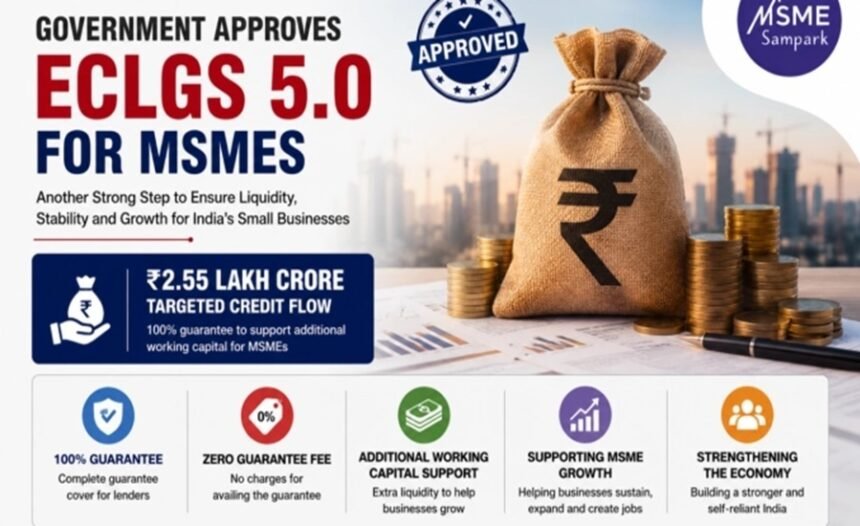
In May 2026, the government introduced ECLGS 5.0, giving eligible MSMEs access to extra credit on top of what they already hold.
Qualifying businesses can borrow up to 20% more than their peak fund-based working capital outstanding from Q4 of FY 2025–26. Lenders are covered by a full 100% guarantee against defaults on this additional credit, so the risk sits almost entirely with the government rather than the bank.
Airlines are treated separately. Scheduled passenger carriers can draw credit up to 100% of their total peak outstanding, covering both fund-based and non-fund-based exposure, though the guarantee for lenders drops to 90% in this case.
Officials expect the scheme to release an additional ₹2.55 lakh crore in credit across MSMEs, non-MSMEs and airlines.
Key Takeaway: Between more SIDBI branches, higher direct lending, expanded refinance support, new digital tools like GST Sahay, and now ECLGS 5.0’s guarantee backing, the credit landscape for MSMEs looks noticeably different than it did five years ago. The next question is whether this credit gets absorbed effectively on the ground, and that’s something the coming reporting cycles will make clearer than any budget announcement can.
MCQ’s:
1. SIDBI is the acronym for:
(A) Small Industries Development Bank of India
(B) State Industrial Development Bank of India
(C) Small Investment Development Board of India
(D) Sustainable Industrial Development Bank of India
2. Under ECLGS 5.0, eligible MSMEs can avail additional credit of up to:
(A) 10% of their outstanding working capital
(B) 20% of their peak fund-based working capital outstanding
(C) 50% of their existing term loan
(D) 100% of their total outstanding credit
Read more: Empowering Women Entrepreneurs: Women-Led MSMEs to Get Free Sustainable ZED Certification